skip to main |
skip to sidebar
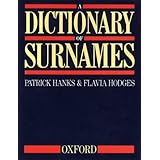 I estimate that the Oxford Dictionary of Surnames by Patrick Hanks and Flavia Hodges (also published as part of the Oxford Names Companion) contains about 35,000 surnames with their etymologies or origins. Yet the number of surnames in Britain must be many more than that, judging by names that crop up in the news but are not to be found in the ODS. And that is without considering names of recent arrivals from other countries. If we add in other English-speaking countries, particularly the United States, the number of current surnames is very large indeed.
 The current crop of Members of Parliament includes one Michael Dugher. I came across his name in the newspaper and was wondering how it would be pronounced. It looks vaguely Gaelic: compare Irish dúghlas ‘dark green’ and its Scottish Gaelic equivalent, which have given us Douglas. But it is not to be found in the ODS.
Thanks to Jo Kim for pointing me to a short video clip in which Mr Dugher says his own name as he identifies himself. This is part of a series of brief goodwill messages from MPs to British troops serving abroad.
As you can hear, he pronounces his surname with the STRUT vowel, as if it were spelt Dugger. As a dictionary entry we would write ˈdʌɡə. Since he speaks with a noticeable northern accent (born and raised in Doncaster, south Yorkshire), he makes no distinction between the STRUT and FOOT vowels, so that this actually comes out more as ˈdəɡə, ˈdʊ̈ɡə.
The preceding clip on the same website is spoken by Mary Creagh, MP for a neighbouring constituency. She says her name as kreɪ, which is what you would expect. According to the ODS this is a variant of Cray, and is an anglicized form of Irish Ó Craoibhe ‘descendant of the curly-headed/prolific one’.
Another MP with a northern accent (born in Rochdale, Lancs.) is Simon Danczuk. He pronounces his name as ˈdæntʃək. (Is the second vowel his STRUT vowel or his schwa weak vowel? This is perhaps a meaningless question. In any case, on the clip he devoices it completely.) This name is not in ODS. It looks as if it would be a Polish diminutive of Dan(iel).
Such video clips offer a useful type of straight-from-the-horse's-mouth resource that was simply not available to lexicographers until very recently.
A correspondent writes that his wife seems to think that the IPA cannot represent the full gamut of human sounds in terms of pronunciation in languages. Not wanting to argue on a point about which I cannot claim to know, I decided to email you.
If it is the case that any language can be represented by the IPA, is there a good book which one can use as a pronunciation reference when looking at IPA? And an unrelated question, can anyone actually really use IPA to speak like a native speaker if they don't have reference sounds (given they could reproduce them if they tried)? I would guess you would need some tutelage in order to properly use IPA...?
 I replied along the following lines.
1. There is no universal enumerable list of discrete “sounds”, and therefore there can be no set of symbols in a one-to-one relationship with them. Rather, we are faced with a multi-dimensional continuum of possibilities. Putting it another way, there is no super multilingual phoneme system in the sky, of which the sounds of each particular language are a subset.
In principle, the IPA contains all the symbols needed to represent the pronunciation of any human language so far described — that is, it is adequate to cover the contrastive sounds (phonemes) of any language. Not all finer shades can be represented except by ad hoc symbols. For example the English ʃ sound in sheep is somewhat different from that in sharp and that in short. But it is not necessary to symbolize these finer nuances. The French ʃ (orthographic ch) is not identical with any of these, being usually “darker” than in English ʃ, nor in the other direction is the Japanese ʃ (orthographic し, romanized sh). However the same IPA symbol will serve for all. For languages that do make phonemic contrasts among sounds that we English speakers would regard as varieties of ʃ, the additional symbols ʂ (less palatal) and ɕ (more palatal) are available. As far as is known, these are sufficient to cater for the ʃ-type sounds of all languages.
2. It is of course true that learning a set of symbols does not equip you to pronounce any language perfectly. Phonetic symbols are a reminder of what you should be aiming for when pronouncing a word in a given language. They still need to be interpreted in the light of detailed phonetic information about that language (point 1 above). And even possession of this knowledge does not automatically give you the articulatory motor skills to perform the sounds accurately.
3. Yes, study phonetics! Or at least consult the IPA Handbook (CUP 1999) and a textbook or two.
More generally, it does seem to be the case that for many people practical phonetic skills are best learned through face-to-face tuition given by an expert. Partly, this is to do with the “hearing bias” imposed on us by our native language. We just don’t automatically hear all the details of speech sounds if those details are irrelevant in our L1. A tutor can draw our attention to aspects we may have overlooked, and perhaps offer ear-training to improve our perception of “foreign” sounds and sound contrasts. It ought to be possible for experts to deliver this kind of tuition through distance learning rather than face-to-face, but that’s something we’re still working on (though we made a start at UCL with PhonLine).
For original investigation into the phonetics of a language, there is no substitute for dealing with a live native-speaker “language consultant” (informant).
 How can we popularize phonetics to a lay audience?
My colleagues Jane Setter and Tim Wharton have just had what can only be called a gig, at an event called Science Showoff, “an open mic night for scientists, science communicators, science teachers, historians and philosophers of science, students, science popularisers and anyone else with something to show off about science.” Grab yourself 10 minutes to show off absolutely anything about science. Got a demo, sketch, song, video, talk, performance, dance or anything else about science that you’d like to try out in public, or show to a new audience? Bring it to Science Showoff.
 Jane and Tim are both tutors on the UCL Summer Course in English Phonetics, as well as holding academic posts at Reading and Kingston universities respectively. They are also both talented singers, with plenty of experience as performers.
Their set comprised some elementary phonetic theory illustrated with two songs, In summer in London and Doing intonation. You may recognize the tunes.
I’m afraid there is no video available. There is a (rather poor-quality) sound recording here. You can listen to it while following the script here. Enjoy the audience participation.
Brilliant.
There was one slight performance error. Where Jane was supposed to say (an exaggerated version of) \really looking ₒforward | to \/science ₒshowoff
she actually produced \really looking forward | to \/science | \/showoff
…which reflects our uncertainty about the stress pattern of newly coined compound nouns. Ideally I think I would have scripted, and performed, \really looking forward | to \/Science | \Showoff
From a review on the Science Showoff website: Highlights for me included ... Jane Setter earworming everyone with songs about phonetics (WHY DID I WAKE UP WITH THE LOCOMOTION IN MY HEAD??!?!) ...
Here's an old picture of Tim and Jane with students at the summer course.
 Have a look at this clip.
As the Guardian comments, the British Prime Minister David Cameron’s declaration in support of gay marriage yesterday at the close of the annual conference of the Conservative party …was revealing, and not only of the oceanic distance that now separates British conservatives from their counterparts in the US, where such a statement is unimaginable from someone in Cameron’s position.
It also supplies us with an excellent example of how intonation disambiguates what would otherwise be a structurally ambiguous assertion.
On paper, the words I don’t support gay marriage might seem to imply that Cameron doesn’t support gay marriage. But if you listen to the clip (and are sensitive to English NS intonation) you will see that he is saying precisely the opposite. He does support gay marriage. He thinks that this support is not opposed to Conservative principles, but follows from them. Like all marriage, gay marriage is a form of commitment, and he’s all in favour of people being committed to one another.
With intonation marked up, his words (0:37-0:45 on the clip) are So ˈI don’t supˈport gay \/marriage | in \/spite of °being a Con°servative. ||
\/I sup°port gay °marriage | because I \am a Con°servative. ||
In English intonation: an introduction (CUP 2006), p. 32, I wrote The fall-rise tone has a special function in a negative sentence. Namely, it indicates that the scope of negation includes the word bearing the nucleus, but not the main verb (unless the main verb itself bears the nucleus). A falling tone, on the other hand, does not restrict the scope of the negation in this way.
I can see now that this wording is not quite correct. It does not cover cases like this, where the speaker chooses to divide his assertion into two intonation phrases, which means there are two nuclei. Here, it is the fall-rise on spite that marks its inclusion in the scope of the negation (‘I support gay marriage, but not in spite of being a Conservative’).
To illustrate this point in my book I chose an example which is (I hope) easier to grasp. (i) She ˈdidn’t do it because she was \/tired. (= She did it, but for some other reason.)
(ii) She ˈdidn’t \/do it | because she was \tired. (= She didn’t do it. Here’s why.)
How many foreign learners, and of what language background, immediately get this intonation distinction? What other languages disambiguate the scope of negatives in this way? What are the implications for mutual intelligibility between NSs and NNSs?
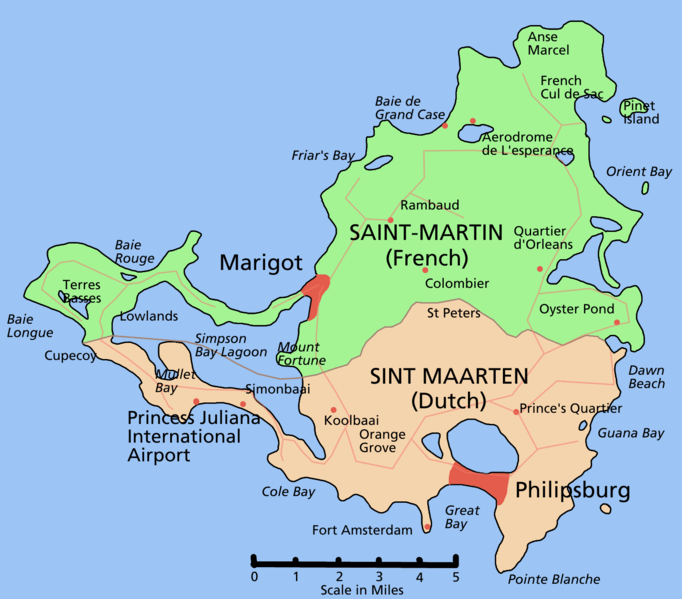 Myra Wandry asked about the pronunciation of “St. Maartens”. She meant the Caribbean island.
This island is divided in two. The southern half is Dutch, the northern half French. (Click on the map to enlarge it.) The border between them is the only land frontier between what is technically the Netherlands and France respectively. The Dutch name of the island is Sint Maarten sɪnt ˈmaːʁtə(n). Its French name is Saint-Martin sɛ̃maʁtɛ̃.
In English it is known as St Martin (BrE) or Saint Martin (AmE), pronounced respectively as sənt ˈmɑːtɪn and seɪnt ˈmɑːrtn̩. The three syllables of this name manage to exemplify four phonological variables.
First, there is the prefix Saint, typically reduced in BrE to the weak form sənt or some further reduction thereof (sn̩t, sn̩ʔ, sn̩, sm̩ʔ, sm̩). Americans generally retain the strong form, seɪnt, perhaps glottalling the final plosive (seɪnʔ).
Next there is the rhoticity variable. Historical r is lost in most accents of England and Wales where nonprevocalic, but retained in most AmE.
The t of Martin is not infrequently realized as glottal in AmE, where it is immediately followed by a nasal consonant. In BrE, where it is usually followed by a vowel (see next point) it is more likely to be alveolar.
Lastly, there is the final syllable of Martin. In most BrE unstressed ɪ does not weaken to schwa before an alveolar obstruent or nasal (thus Harris ˈhærɪs, goblin ˈɡɒblɪn). In AmE, on the other hand, it usually does (so ˈherəs, ˈɡɑːblən). In AmE, accordingly, Martin usually rhymes with Parton, Barton, carton; in BrE, it usually doesn’t.
After t or d, as usual, the schwa coalesces with a following sonorant to give a syllabic sonorant, i.e. ən → n̩. So Latin is pronounced ˈlætn̩ and Martin is pronounced ˈmɑːrtn̩. These in turn yield possible ˈlæʔn̩, ˈmɑːrʔn̩.
Despite having Dutch as the official language, most of the inhabitants of the English Dutch side speak Caribbean English as their L1. Some speak Papiamento. One of the most famous things about the island of St Martin is the way aircraft landing at the airport pass just a few feet over a popular beach.
 I’ve been thinking again about the example I quoted on Friday, I fee[lʲ] ill vs. I may not look ill, but I do fee[ɫ] ill.
The only reasonable hypothesis I can come up with is that the ‘boundary’ that triggers the dark l is the end of a focus domain.
Marked up for intonation, we have
I ˈmay not \/look ill, | but I ˈdo \/feel ill ||
or perhaps
I ˈmay not \/look ill, | but I ˈdo \feel ill ||
In pragmatics, focus is the foregrounding of part of the message — typically what is new or contrastive or otherwise important — and the backgrounding of everything else. It is realized in intonation as the presence of accented syllables, i.e. syllables that are not only rhythmically but also intonationally prominent (pitch-prominent). Identifying the beginning of each intonational ‘focus phrase’ or ‘focus domain’ is sometimes tricky, but identifying the end is easy: it ends at the end of the word in which the nuclear accent appears (= the last accented syllable in the intonation phrase).
So in this example the focus domain in the first IP extends from may to look. The focus domain in the second IP is do feel. My hypothesis is that here the l in feel, being focus-final, is made dark even despite its prevocalic environment.
This is not a matter of being ‘prepausal’. In the example given, the phrase feel ill is not interrupted by any pause or intonation boundary.
Of course it would also be possible to place an intonation boundary and possible pause there.
You ˈmay not be able to \/see anything unusual, | but I ˈdo \/feel | \ill ||
As we know, any lateral that is prepausal is dark. This applies whether or not it is also focus-final.
You’re \i[ɫ] — (You’re wrong!) I’m /not i[ɫ]
I tried some more examples, and introspecting I think they work.
This is ˈNell \Anderson. (nelʲ)
ˈPlease /welcome | ˈJames /Anderson | and his ˈwife \Nell Anderson. (neɫ)
There’s a ˈsmall \error. (smɔːlʲ)
ˈNot a \/big error, | but a \small error. (smɔːɫ)
The big question, which I’ve never asked myself before, is this: are there any other instances of allophonic variation triggered by focus-final position? (The idea that this might apply to linking r, floated in the discussion on Friday’s blog, seems to me to be a non-starter.)
The British government has announced the creation of three new enterprise zones to help the workers who are losing their jobs at Brough, Warton, and Samlesbury, we read yesterday.
The Brough in question is not Brough under Stainmore in Cumbria but Brough-on-Humber near Hull. Like other English places with this name, both are pronounced brʌf (locally, of course, equating to brʊf). In Scotland things are different.
 Warton is of course ˈwɔː(r)tn̩. This village is in Fylde faɪld in Lancashire. Samlesbury, too, is in Lancashire, just outside Preston, not too far from where I grew up. (My picture shows the village church.)
There is some uncertainty about the first vowel sound in this latter place name. I know it as ˈsɑːmzbri, -bəri, though I see that in LPD I deferred to the BBC Pron Dict of British Names and prioritized ˈsæmz-. Either way, its pronunciation does not correspond particularly closely to its spelling. In fact it is pronounced more as if spelt Salmesbury — compare psalm sɑːm and salmon ˈsæmən.
This YouTube video, too, calls it ˈsɑːmz- (or is she saying ˈsɒmz-?).
Wikipedia baldly asserts that the etymology of the first part of this name is the Old English sceamol ‘ledge’. Ekwall’s Concise Oxford Dictionary of English Place-names is more cautious, saying only “Etymology obscure. If the name originally began in Sh-, the first element may be OE sceamol ‘bench’ &c. in some topographical sense such as ‘ledge’”. The earliest spelling recorded (1179) is Samerisberia, with Samelesbure in 1188 and Schamelesbiry in 1246. The English distinction between ɑː and æ is much more recent than that.
 The current crop of Members of Parliament includes one Michael Dugher. I came across his name in the newspaper and was wondering how it would be pronounced. It looks vaguely Gaelic: compare Irish dúghlas ‘dark green’ and its Scottish Gaelic equivalent, which have given us Douglas. But it is not to be found in the ODS.




 Posts

