Friday, 30 October 2009

Wholly holy

Have a look at the second of these “word picture” puzzles in yesterday’s London Lite.It consists of the words RELIGIOUS TOME perforated with a number of holes. The answer is “The holy bible”.
It depends, then, on the homophony of hole-y (full of holes) and holy (sacred). But they are not homophones for the many speakers in England who use a special allophone [ɒʊ] for /əʊ/ before morpheme-final /l/. (These are the people for whom a goalie, where the /l/ is morpheme-final, doesn’t really rhyme with slowly, where it is morpheme-initial.) I think everyone probably pronounces hole-y identically with wholly. In both the /l/ is treated as morpheme-final. But in holy it isn’t.
I discussed this in my blog of 31 July 2006, and will repeat here what I wrote then.
I recounted how, when I was a small boy and couldn’t sleep one night, my father told me the Bible story of Moses and the burning bush (Exodus 3).
In the words of the Authorized Version, God spake unto Moses from out of the midst of the bush and said, “Draw not nigh hither: put off thy shoes from off thy feet, for the place whereon thou standest is holy ground”.
But I heard this as hole-y ground, ground with holes in it. (If Moses kept his shoes on, I thought, perhaps he would get them caught in the holes.)
This implies that my late father pronounced [ˈhəʊli] holy ‘sacred’ and [ˈhəʊli] hole-y ‘containing holes’ identically — like me, and unlike the speakers mentioned above.

Thursday, 29 October 2009

’un

I don’t know when or why one lost its weak form /ən/ in standard accents. It remains, with the spelling ’un, as a dialectal or jocular form. When I was a boy there was an evening sports paper called The Pink ’Un.

I imagine it was used only for dummy one after an adjective, as in a green ’un, a new ’un, a big ’un. That seems to be the position in those forms of English that retain it. I don’t think anyone would use it in contexts such as *I’ve got ’un, even though the dummy pronoun one in I’ve got one is normally unaccented.

Today’s Guardian has a picture of a small lemur with the headline Hallo wee’un, one of the worst puns for months. Since it doesn’t seem to be on their website, I have scanned it for your delectation.

Wednesday, 28 October 2009

corn beef and fry rice

Sili (24 October) mentioned the rivalry between “boxed set” and “box set” or “boxset”. A favourite example of this phenomenon that I used to use in my teaching days is “corned beef” (which is what it says on the tin) and “corn beef” (which corresponds to what we mostly say).
The principle this illustrates is that final /d/ in a consonant cluster is susceptible to elision when the next word begins with a consonant sound. In the case of a lexicalized phrase such as corned beef, people learn the pronunciation in its reduced form and may be unaware of the full form underlying it. They then spell it in accordance with the reduced pronunciation, which is for them the only pronunciation.
In Google, corn beef gets 180,000 hits, as compared with 1,450,000 for corned beef, a ratio of 1:8.
The books don’t tell you this, but I think this elision is less usual before /r/. I don’t think I can omit the /d/ from boiled rice.
I certainly can’t omit it in fried rice, where the final /d/ is not in a cluster and therefore not a candidate for elision. In Google fry rice gets 37,000 hits as compared with the 2,190,000 for fried rice, a ratio of 1:59.
In Chinese English, however, fry rice seems to be quite frequent. Here’s a picture of some “fry mushroom”.
In cases such as stir-fry rice noodles I think we have to analyse stir-fry as a nominalization of the verb (“noodles for stir-frying”).

Tuesday, 27 October 2009

How do you spell that address again?

Until now, a url has had to consist only of ASCII characters (and not even all of them are allowed). According to reports in the press, this is about to change. As from the middle of November “domain names written in Asian, Arabic or other scripts” will be allowed.
This is only fair. Everyone ought to be allowed a domain name written in their own usual writing system.
I haven’t seen the details yet, but this presumably means that we will be able to start using domain names and urls written in IPA symbols, too.
I look forward to encountering email addresses like dʒɒn_smɪθ@lʌfbrə.ac.uk. (More seriously, email addresses like корженков@москва.ru and νικολάϊδης@αθήνας.gr will presumably become available, as well as the equivalents in Chinese, Japanese and Korean.)
That means that a whole new group of users will need to be taught how to enter Unicode characters into their email programs and web browsers. Not only will the Japanese need to be able to enter Latin letters with their keyboards, as now, but the English will need to be able to enter kana characters. And Chinese. And IPA.

Monday, 26 October 2009

sh!

As we know, English [ʃ] can be spelt not only sh but also in a number of other ways, as seen in the examples ocean, machine, precious, sugar, conscience, compulsion, pressure, mission, creation. However, sh is clearly felt as the basic way to spell this sound in English. Why? Why did we choose this particular digraph?
Historically speaking, the basic problem is that classical Latin had no palatoalveolars. In consequence, languages which use the Latin alphabet and which do have these sounds have not inherited any single way of representing them.
Greek had and has no palatoalveolars, either. So the Greek alphabet, too, lacks a letter for the sound [ʃ].
In Cyrillic, on the other hand, there is a letter used for just this purpose: Шш, presumably modelled on the Hebrew letter shin ש. This is also the origin of the Arabic ش.
The Armenian and Georgian alphabets also have special [ʃ] letters, upper- and lower-case: Շշ and Ⴘშ respectively.
Getting back to the Roman alphabet, I do not know why the predominant English way of writing [ʃ] is the digraph sh. French expresses this sound as ch. Words that in standard French now have [ʃ], and are so spelt, are (or were) pronounced in Norman French with [tʃ], and that is supposed to be the reason we use ch in English for the affricate.
For our fricative German writes sch and Polish sz. Does anyone know the historical reasons for these choices?
Hungarian writes it with the simple s, reserving the spelling sz for the sound [s]. Czech, Slovak, Lithuanian, Latvian, Slovene and Croatian all use the háček-bearing š. Romanian and Turkish use a subscript cedilla or comma, ş.
We’d better not go into Swedish too deeply: rs, sj, kj.

Friday, 23 October 2009

tex(t)ing

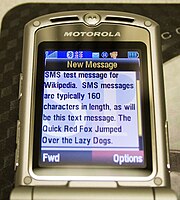
An SMS, a short message that you send or receive using your mobile phone (AmE cellphone) is generally known as a text. This word is also used as a verb and verbal noun: texting. (I see that David Crystal is giving a talk today at Berkeley entitled “From texting to tweeting: the brave new world of internet linguistics”.)


But what is the past tense of this verb?
Leo Holroyd asked
What is your opinion on the past form of the verb "text"? Many people use "text" rather than "texted" in the past tense (in both speech and writing), which is clearly irregular, and to me surprising. I can only guess that it has something to do with the unusual ending "-ext". Is it common for verbs to become irregular for this sort of reason?
He’s right. Many people, in Britain at least, use [tekst] as the past tense. I suppose we could spell it texed.
You can see how this has arisen. The final cluster [kst] is highly susceptible to losing its final consonant, particularly when followed by a consonant sound.
ðə neks(t) θɪŋ
ə bɒks(t) set
ə mɪks(t) ɡrɪl
— in all of these it’s usual for the final [t] to be elided (lost) except in very careful (over-enunciated) speech. Likewise we say
teks mesɪdʒɪz
aɪl sen ju ə teks wen aɪm redi
ðə wər ə həʊl lɒt əv tekss weɪtɪŋ fə mi
— so that [teks] can come to seem to be the basic form.
Then, just as the plural of box [bɒks] is boxes [bɒksɪz], so [teks] seems to need the plural [teksɪz]. And just as the past tense of box is boxed [bɒkst], so the past tense of tex(t) comes to be [tekst].
Indeed, [ə teks(t) mesɪdʒ] could then be interpreted as a texed message, one that you can tex to someone.
It may seem shocking to us highly literate people. But many users of text messaging are not highly literate (though I agree with David Crystal that text messaging, by encouraging people to read and write more frequently, helps literacy rather than hindering it).
I should think that the contex(t)-free pronunciation [teks] for the verb will persist.

Thursday, 22 October 2009

Che cosa? ¿Qué?

In the male-voice choir I belong to we warm up thoroughly at the start of every rehearsal. This involves body mobilization like the exercises that actors do, humming, and singing scales to syllables such as ba, mɛ.
After that we sing scales to words. One exercise we often do involves going up and down doh-mi-so-dohʹ…doh…, usually to the words I am a zebra (with /e/, of course, not /iː/, because we’re mostly British) or I am a walrus (where some sing /ɔː/ and some /ɒ/, as you might expect).
But there’s another set of words we sing to this that I don’t know how to spell. Phonetically they go ˈbe la se ˈnjɔ ra. Presumably they mean “beautiful lady”: but in what language? Probably most people in the choir think they’re Spanish, though the sprinkling of native speakers of Spanish that we have could quickly disabuse them: señora is fine, but not *bela. They’re not Italian, either: here bella is fine, but not *segniora.
No, this phrase is a hybrid. The first word is Italian (sort of), the second one Spanish (sort of — we can’t manage a proper ɲ, of course). I wonder where it came from.
And before you ask, it’s not Esperanto either.