Monday, 31 May 2010

Sparta history, innit?

You remember the man who took his torn trousers to the Greek tailor? The tailor asked, Euripides? Yes, said the man, Eumenides?

Every now and again the Guardian letters column sports a series of punning contributions on some particular theme. Just at the moment the theme is Greek.

For pitta’s sake! Have we not been punnist enough by all these ill-bread Guardian readers ouzo lack a sense of houmous?

I can’t understand the calls for an end to the Greek letters. We know the Guardian enjoys themed correspondence. Sparta the letters page ethos.

I hope you Argoing to stop these Greek letters. Some take a minotaur so to understand. Others made me feel so Iliad to stop reading.

This last one doesn’t work for those of us who pronounce ˈmaɪnətɔː rather than ˈmɪnətɔː — which means it doesn’t work for most Brits, or at least most British classicists. I imagine Americans, though, will twig minute or with no hesitation.

Here’s Saturday’s effort. As always, you do have to know how the relevant names from Greek mythology and history are pronounced in English.

There are Menelaus of subtlety to Dis Greek correspondence. Please maintain it or Alcibiades newspaper no more.

In RP the difference between Menelaus and many layers may be no more than the difference between s and z. Scandinavians would find the two perfect homophones.

Alcibiades is ˌælsɪˈbaɪədiːz, and I think you have to be generous to interpret it as I sh’ll buy this (?).

In other news, the Faculty of Classics at the University of Cambridge has egg on its face because the Greek inscription on the glass doors of its new building is misspelt: it has a Latin S instead of a Greek sigma Σ.
O tempora, O mores!

Friday, 28 May 2010

ah!

The English spelling ah is “unambiguously a long open vowel spelling” (Carney). Apart from interjections (ah!, bah!, hurrah!, pah!), it is found mainly in foreign names, such as Ahmed, Bahrein, Brahmin, Brahms, Kahn, Mahdi, Mahler, Shah. In all of these ah stands for ɑː.

In final unstressed position, true, ah represents the corresponding weakened vowel, ə, as in cheetah, hallelujah, loofah, messiah, rajah, Delilah, Jeddah, Sarah; but in stressed position and in monosyllables its “value” as ɑː is so self-evident that it is confidently used in respelling systems for native speakers of English.

Thus we Brits caricature Americans as saying Gahd instead of God; we represent Cockneys as saying dahn instead of down; and northerners think southerners say glahss instead of glass.

Yet there are two words with this spelling that constitute exceptions. One is Fahrenheit, which for most English people has æ rather than ɑː. The other is dahlia, the name of the flower, which in BrE is ˈdeɪliə. The OED (2nd ed.) gives the pronunciation of this word rather prissily as “ˈdeɪlɪə, properly ˈdɑːlɪə”. But DJ’s EPD (12th ed.) gives only ˈdeɪl-, and that is all I give for BrE in LPD. (Americans, on the other hand, may well say ˈdæl- or ˈdɑːl-.)

What I wonder is when, how, and why the pronunciation of dahlia became the norm in BrE. Carney says vaguely
this is derived from the name Dahl /dɑːl/, but with popular use has become anglicized…

The OED’s first citation is dated 1804, two centuries ago. If the name had been first introduced more recently, say since 1950, I think there is little doubt that we would all be saying ˈdɑːliə, “popular use” or not. OK, yah?

Thursday, 27 May 2010

labiodental flap

Jo-Anne Ferreira sent me a message saying she was
hunting high and low for a Unicode font that has the labiodental flap. Can you help?

The answer was easy: the symbol she needs is already available in the SIL fonts she uses regularly. The problem is knowing where to find it among the thousands of characters in the fonts. And the place to find it is at Unicode number 2C71.

The voiced labiodental flap symbol is the newest letter to be added to the IPA chart inventory, though it has now been with us for several years. It was the topic of one of the very first entries in this blog (25 March 2006), where I reported that it had been added to the widely-used SIL phonetic fonts, Charis SIL and Doulos SIL. The last time we mentioned it was two years ago (blog, 16 April 2008).

It was adopted by the IPA too late to make it to the most recent printed Unicode standard, 5.0. However it was added for the Unicode 5.1 revision, and you’ll find it in the current on-line Unicode charts.

So, briefly, here’s what you need to know: the labiodental flap symbol is at U+2C71 LATIN SMALL LETTER V WITH RIGHT HOOK. It is included in the current versions of the SIL fonts Charis, Charis Compact, Doulos and Doulos Compact, and also in the font Code 2000. However, it is not found in the Microsoft fonts routinely supplied with new PCs, nor in Lucida Grande. So PC users will need to download and install specialist fonts. I imagine Mac users will too.

Tiresomely, Unicode did not add it to one of the blocks where phonetic symbols are usually found (IPA Extensions, U+0250–U+02AF; Phonetic Extensions, U+1D00–U+1DBF). Instead, it is in a small block called Latin Extended-C (U+2C60–U+2C7F), nestling unobtrusively between Glagolitic and Coptic. Within that block it lies among the “miscellaneous additions” located between “Additions for Uighur” and “Claudian letters” (Latin letters invented by the emperor Claudius but soon dropped). It’s not surprising that people say it’s hard to find.

If your browser settings are favourable and you have a suitable font, you may be able to see the symbol here: , or in a larger size ⱱ.

Wednesday, 26 May 2010

Jamaican


The disturbing news of urban warfare in progress in Kingston, Jamaica, has led me to have a look at the website of the venerable local newspaper, the Gleaner. I hope it is not insensitive in the middle of such tragic events for me to comment on matters of language.
The news report is written in standard English, the regular language of educated and official discourse in the island. This poses the question: how best can the paper record the words spoken in Jamaican Creole, the words actually uttered by witnesses and bystanders? Particularly in its most extreme (basilectal) form, JC can be very distant from standard English. The JC orthography devised by academics, now being trialled in literacy projects (blog, 13 August 2008), is still very unfamiliar to most Jamaicans. Instead, the Gleaner uses standard English spelling where possible, and ‘phonetic’ representations based on ordinary spelling conventions where not.
“A nuff shot dem a fire and all bomb a drop from helicopter,” said one caller to our news centre.
The Gleaner’s local readers will be able to interpret this as meaning “there’s a lot of gunfire going on, and they’re even dropping bombs from helicopters.” A word-for-word gloss would be “is plentiful shot they PROG fire and even bomb PROG drop from helicopter” (where PROG means the particle denoting the progressive aspect of the verb, English be …-ing).
In the JC orthography devised by Cassidy & Le Page and used in the Dictionary of Jamaican English and the literacy project, this would be spelt (or transcribed) a nof shat dem a faia and aal bam a drap fram helikapta.

“Me hear say me daughter-in-law dead and all people house bomb down. Dem a go kill we off in yah and decent people live yah,” another woman said, in tears.

That is, “I’ve been told that my daughter-in-law is dead and that people’s houses have even been destroyed by bombs. They are going to kill us all here, and there are decent people living here.” (“PRON1sg hear COMPLEMENTIZER PRON1sg daughter-in-law dead … PRON3pl PROG go kill PRON1pl completely in here …”) mi hier se mi daata-in-laa ded an aal piipl hous bam doun. dem a go kil wi aaf in ya an diisn piipl liv ya.
“A true me neva have nowhere fi come out go. Me ’fraid, me ’fraid, me ’fraid,” added the woman as she held her phone close to the window to allow the news team to listen to the explosions.
"Where is the prime minister? Him is we member of parliament and now that them a kill we, him not here. When them want votes, them come down here come party, but now that the police dem a kill we, nobody not here.”

The woman’s question is couched in standard English. The JC equivalent would be A-weh the prime minister deh? a we di praiminista de?
The other news from Jamaica this week has been the launch of the audio version of the Bible in JC (aka Patois). This audio clip includes some short passages.

Tuesday, 25 May 2010

conferences

I don’t know if this is happening to everyone else, too, but I keep getting emails purporting to be a Call for Papers for a conference called ICT 2010, devoted to “Infocomm Technologies in Competitive Strategies”, due to be held in Singapore in October this year. I looked at the first one or two, but now just delete them as spam, unread. (Three came today.)
Looking at the conference website I am struck by the clumsy English it contains. Or is this just our old friend/enemy English as a Lingua Franca?
Innovation in the Infocomm Technologies have revolutionized the world and provided with a born-global platform that delivers rich information on every imaginable subject and enables the unprecedented integration of social information.
ICT Symposium would be held at the grandiose locale of the conference. The Symposium hall will have the latest state-of-the-art facilities conducive to the requirement standards of the national and international organizations participating in the Symposium.

“Innovation ... have revolutionized ... and provided with ...”? Come again? “Conducive to the requirement standards”? Sorry? We know that an inability to use accurate English is one of the characteristics of fraudulent spam.

I have no knowledge of “infocomm technologies” and no interest in the related “competitive strategies”, so I will not be attending this conference. But I have to ask whether it is really a wise “competitive strategy” for an academic conference to behave like a spammer.

— — —
The biggest international phonetics conference is the four-yearly International Conference of Phonetic Sciences. The next ICPhS, following Barcelona in 2003 and Saarbrücken in 2007 (blog, 13 August 2007), will be held in Hong Kong in 2011. The dates are reportedly 16–20 August. Unlike ICT 2010, ICPhS 2011 has not yet provided any information (even such basic information as the conference venue) and has no website, or none that I can discover. I hope we shall soon get to see a Call for Papers. One, or perhaps two, but not three a day for week after week.

Monday, 24 May 2010

infantilism

In LPD one of the innovations I introduced (as compared with the then EPD) was a set of entries devoted to affixes and combining forms. This was actually one of the most difficult parts of the book to write: I had to try to distil the contents of works such as Erik Fudge’s English Word Stress (HarperCollins, 1984) into something snappy and clear at each entry.

So my entry for -ic, for example, reads as follows:
-ic stress-imposing ɪk —periodic ˌpɪər i ˈɒd ɪk || ˌpɪr i ˈɑːd ɪk

The example(s) were meant to be carefully chosen to show the stress effect (if any) of the affix. Here, -ic causes stress (and therefore a strong vowel) on the preceding syllable -od-, which in the base form period is unstressed and weak.

I didn’t attempt to provide lists of exceptions (if any). In the case of -ic there are hundreds and hundreds of regular cases, alongside a handful of exceptions such as Arabic, catholic, heretic, rhetoric.

Last week I was brought up short by the word infantilism. This word is stressed on the -fant-: ɪnˈfæntɪlɪzəm. Why?

Comparison with the base forms infant, infantile, both with main stress on the initial syllable ˈɪn-, shows that this change of word stress placement must be attributed to the suffix -ism. (I shall ignore the question of whether or not we wish to recognize a secondary stress on the suffix itself.)

Yet -ism is one of the suffixes usually regarded as having no effect on stress. Think of radicalism, clericalism, feudalism, parochialism, imperialism, capitalism, territorialism, nationalism, liberalism, journalism, naturalism, fundamentalism, creationism, magnetism, relativism, negativism and large numbers of other cases.

Are there any other words like infantilism, in which the suffix appears to impose stress on a syllable different from that stressed in the base form?

In mechanism ˈmekənɪzəm and evangelism ɪˈvændʒəlɪzəm the stress goes on the second syllable back from the suffix: compare mechanic(al) mɪˈkænɪk(əl) and evangelic(al) ˌiːvænˈdʒelɪk(əl), in which -ic has its usual effect. There’s no base form *mechan, though there is a combining form mechano- ˌmekənəʊ-. There’s a rare word evangel ɪˈvændʒəl (OED: “now arch. or rhetorical”). There’s no obvious base form for monotheism, polytheism, synergism or syncretism.
In the case of catholicism kəˈθɒlɪsɪzəm the suffix -ic regains its usual ability to impose stress on the preceding syllable, despite its failure in catholic.
There’s some uncertainty or variability about word stress placement in opportunism, obscurantism, mercantilism and Adventism.

So perhaps the best pedagogical rule would be:
-ism has no effect on word stress. There are two important exceptions: catholicism and infantilism.

Friday, 21 May 2010

Orme

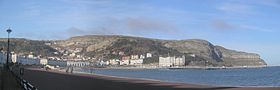
Llandudno Bay is flanked by two steep headlands sticking out into the sea, the Great Orme ɔːm and the Little Orme. As we gazed on the Great Orme, one of my friends asked me the etymology of ‘Orme’. I said I thought it was probably a form of worm. I was aware that in the Gower in south Wales there is a promontory called Worm’s Head, and I had a sort of feeling that orm was the Norse or Danish word for ‘worm’.
I was nearly right. But my questioner wasn’t satisfied. How, then, she asked, was this great headland similar to a worm, an earthworm?
What I had forgotten was that the English word worm used to mean ‘serpent, snake, dragon’. Orm still has that meaning in Scandinavian languages, though in English this sense had died out by about 1800.
It is easy to imagine how seafarers could liken this headland to a dragon or a snake.
According to Owen and Morgan, Dictionary of the Place Names of Wales, the Orme at Llandudno is from ON ormr ‘snake’, but Worm’s Head in the Gower is from OE wyrm.

The Welsh name for the Great Orme is Y Gogarth. Fancifully, I wondered if that had any connection with arth ‘bear’ (cognate with Greek ἄρκτος árktos), with an intensifying go- and a hypercorrect initial prevocalic -g- as in gwyneb for wyneb ‘face’. Then it could mean ‘great bear’. But no, apparently the earlier form was gogerdd, meaning merely ‘ledge, terrace’. Very disappointing.