skip to main |
skip to sidebar
It is good from time to time to stand back and consider what the phonetics of familiar languages look like from the perspective of language universals, and how they might appear to those who don’t know them.
Vowel systems of different languages vary widely in size.
The ever-fascinating World Atlas of Language Structures Online devotes the second of its 142 “feature” articles to Vowel Quality Inventories. There is (i) a narrative discussion and (ii) a customizable map of the world plotting vowel systems with unusually small (2–4) or unusually large (7–14) inventories. Various theoretical or procedural issues, such as the status of diphthongs, have to be settled before you start counting. That done, though, the average number of vowels in a language turns out to be just fractionally below 6. The smallest vowel quality inventory recorded is 2 and the largest 14. (Click here for the full-size map.)
And which language would hold that record number of fourteen vowels? Standard German! (Count them: iː ɪ eː ɛ aː a yː ʏ øː œ uː ʊ oː ɔ, to which you could of course add ɛː for some speakers. The weak vowels ə ɐ are not counted, nor the nasalized vowels used in borrowed French words.) The “variety of British English included here” is reckoned to come in equal second place, with thirteen. Its posited inventory presumably comprises iː ɪ e æ ɑː ɒ ɔː ʊ uː ʌ ɜː eɪ əʊ, the last two being regarded as unitary. Not only the remaining diphthongs but also schwa are excluded.
Considerably more languages have an inventory of five vowels than any other number — just over a third of the sample. Familiar examples would be Spanish, Greek, Japanese and Swahili, all with just i e a o u.
Polish adds one more, ɨ, giving six vowels (ignoring the nasalized ones, which we can arguably analyse away). Korean adds two, ʌ ɯ, giving seven.
Four languages in the sample have only two contrasting vowel qualities.
You can see why many foreign learners of English (but not speakers of other Germanic languages) would find the English vowel contrasts so difficult to master. Not to mention foreign learners of German.
_ _ _
No posting tomorrow. Next: 2 December.
 On Friday, as I watched live television coverage of the result of the by-election in the Irish Republic, I was astounded to hear the returning officer for Donegal South-West pronounce the name of the party in third position, Fine Gael, as faɪn ɡeɪl. The results in English, in which I heard this, were preceded by the results in Irish, but since the Sky News commentator saw fit to talk over the Irish-language results I could not hear what she may have said when pronouncing this name in an Irish-language context.
We English know that we are supposed to pronounce the first word of Fine Gael as ˈfɪnə. How come this Irish lady doesn’t know that? Or was it just a slip due to nervousness?
In Irish, I believe, both consonants in Fine are palatalized, making the name of the party in Irish ˈfʲɪnʲə ˈɡeːɫ̪.
 Compare the name of the other major party, Fianna Fáil ˈfiənə ˈfɑːlʲ, usually anglicized as ˈfiːənə ˈfɔɪl. The pronunciation of the first word is confusingly similar to Fine. The second word, Fáil, is alternatively anglicized as fɔːl, though this is appropriate really only for speakers who make all ls clear, as most Irish people do. In Irish I think it must be the genitive of a noun with the nominative form fál: the lateral would be velarized in the nominative and palatalized in the genitive. We map this palatalization onto the second part of the English ɔɪ diphthong.
 The winning party in Donegal SW was Sinn Féin. We all know how to pronounce that in English: ˈʃɪn ˈfeɪn. Looking at LPD, I find I give the Irish as ˌʃin̪ʲ ˈheːnʲ. Although this has remained unchanged in LPD since the first edition twenty years ago, I think it must be wrong. Wikipedia says it should be ʃɪnʲ fʲeːnʲ, which I am inclined to believe. Perhaps someone who knows Irish can set us straight. Where did I get the idea that the f- is lenited to h here? Anyhow, surely the lenition product of f is zero? And if there were lenition here, surely it would be signalled in spelling? How come no one has complained about the entry, or reported the mistake (if that is what it is)?
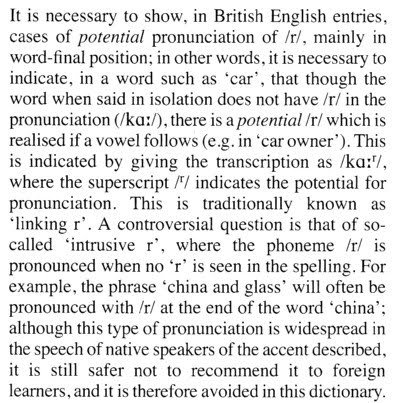
And so finally to LPD. Rather than omit reference in the entries to possible intrusive r like EPD, or use an ad-hoc notational convention like ODP, for LPD I applied a notational convention not restricted to the matter of intrusive r. Namely, LPD divides “optional sounds” into two categories. Those shown in italics are “sounds which the foreign learner is recommended to include (although native speakers sometimes omit them)”. Those shown as raised letters are “sounds which the foreign learner is recommended to ignore (although native speakers sometimes include them)”. Put another way, sounds shown in italics may optionally be elided; those shown raised may optionally be inserted.
Since both categories are optional sounds, what is the basis for distinguishing them? You may well ask. It is covertly orthographic, though not only orthographic. The t segment that some but not all speakers use in mints mɪnts is reflected not only in the spelling but also morphologically, since the t of the singular mint is not a candidate for elision. In mince mɪnts, on the other hand, there is no such support for the plosive used by some but not all speakers.
Here is what LPD says about linking and intrusive r.

Since LPD, unlike the other dictionaries, transcribes in full the inflected forms of monosyllabic verbs, its entries for saw, -ing and soar, -ing are longer, more explicit, and therefore more complicated.

 Here is the entry for withdrawal.
 A word on my own personal usage. I use intrusive r freely after ə, ɑː and the centring diphthongs, even word-internally, but never after ɔː. So I would readily put an r in china and glass, Grandma again and even in semi-nonce forms such as concertinaing, magentaish; but not in thaw out, sawing, withdrawal. Historically, I think this constitutes an intermediate step between an earlier generation (DJ) that still distinguished ɔə (soar) from ɔː (saw), with consistent r links after the first but not after the second, and later generations for whom the two categories are entirely merged as ɔː. You could say that those like me have the phonetic merger of the two categories but not yet the phonological (lexical) merger.
You may think that the theoretical underpinning of the distinction between optional elision and optional insertion is weak. In its defence I would say that it does nicely cater for (i) usage such as my own, consistently distinguishing mints – mince and sawing – soaring, and (ii) statistics such as those furnished by Hannisdal, who showed that in newsreaders’ usage linking r was found significantly more often than intrusive r, even though both categories are frequent.
Some of Monday’s commentators will be pleased, some annoyed, if I now take up the question of whether the use of intrusive r is to be regarded as a characteristic of RP.
As I see it, the answer depends on how you choose to define RP. Do you consider it - the implicitly agreed model of good BrE speech?
- a codification intended mainly for EFL pedagogical purposes?
- or an objective description of how people at the top of BrE social stratification actually speak?
Let us examine the three specialist pronunciation dictionaries from this point of view.
Here is what the Cambridge English Pronunciation Dictionary, says (17th edition, 2006, Daniel Jones, edited by Peter Roach, James Hartman and Jane Setter) on the subject of r links.
 So as far as intrusive r is concerned you could say that EPD prioritizes “safe” advice to learners over the documentation of reality.
The raised r symbol replaces the asterisk used by Daniel Jones in earlier editions of EPD. While recommending foreign learners to use linking r only in such cases, Jones also (12th edition, 1963) carefully and in great detail explains how intrusive r in words ending in ə, ɑː, ɔː but not transcribed with the asterisk “is a very noteworthy feature of south-eastern English”. In the current EPD, Jones’s page-long discussion has been reduced to the two sentences you see here.
The environment in which intrusive r is perhaps most disfavoured is in word-internal position, between a stem and a suffix beginning with a vowel sound. Thus the pair sawing and soaring are distinguished by some, but certainly not by all, real-life RP speakers. EPD, in line with its policy stated above, entirely ignores the possibility of an r link in the former.


Tomorrow we’ll look at ODP.
 Transport for London is the body responsible for running London’s public transport services. Like the railway companies, to general derision, it now calls those who travel on its trains and buses not “passengers” but “customers”. (You can even argue that a child or a pensioner, who in London can travel free of charge, is not actually a customer at all. A customer is “someone who buys goods or services from a shop or company”. But that is by the way.)
Here is a recorded announcement I heard at a tube station recently.
\/Customers are re°quested | to ˈtake their ˈlitter \home with them.
As you can tell if you say this aloud, the lady making the recording spoke the right words but used the wrong intonation for them. The intonation pattern that she used bears an implication that the request is aimed at customers, but not at others. It implies a contrast between customers and some other possible subject. We might gloss this implied meaning as ‘although those who are not customers can leave their litter behind’.
What she ought to have said was
ˈCustomers are re\/quested | to ˈtake their ˈlitter \home with them.
or just
ˈCustomers are reˈquested to ˈtake their ˈlitter \home with them.
If she had placed the intonation break differently and said
\/Customers | are reˈquested to ˈtake their ˈlitter \home with them.
then the fall-rise could have been interpreted as signalling merely non-finality, rather than the inappropriate contrastivity.
Dwight Bolinger has a number of further examples of people using the wrong accentuation (wrong tonicity) when reading scripted material aloud. Taken from broadcasts over San Francisco radio stations, they are to be found in Chapter 16 of his Intonation and its Uses (Edward Arnold, 1989). Here is one.
Some restrictions apply.
Bolinger comments “There is nothing that a restriction can do but apply.” It ought to be Some restrictions apply.
Bolinger concludesMaybe all this should be excused simply as the ingredients of a professional style. But for the constant listener it would be restful if occasionally the newscasters and their associates would just COOL IT. A daily exercise in taming the wild accents and toning down the ends of sentences might help.
Nannying station announcements are different from the compelling urgency of newscasters. But their use of inappropriate intonation can be just as annoying.
 The reason that I was unable to post on Thursday and Friday of last week was I was attending funerals, one on each day.
West Indian funerals are different from English ones. In particular, they are attended by several hundred people, whereas for English funerals there are often no more than a handful of mourners, or at most a few dozen. (Funerals of public figures or particularly well known people are an exception.) For a West Indian funeral, everyone who knew the deceased is expected to attend; and those who did not know him or her personally, but know one or more members of the family, are under an obligation to attend in order to show respect. For funerals in London, special coaches are often laid on to bring mourners from Birmingham or Leicester. Other mourners fly in specially from the United States or the West Indies.
For Friday’s funeral I did not know the deceased, a man in early middle age, but I do know his mother and so was happy to be there in her support.
So now, at last, to phonetics — or rather to spelling and what it implies about pronunciation. Here is an excerpt from a tribute printed on the back cover of the service booklet.
 I will never hear you call me Marr again. In non-rhotic English English, Marr is a homophone not only of mar but also of Ma. All three are mɑː. In the context of the following ə in again an r-link is to be expected: if the preceding word were indeed Marr we would call it linking r, but since it is properly Ma we would call it intrusive r. Misspelling Ma as Marr is entirely understandable.
But that is not the end of the story. I do not know who typed up the service sheet, but I surmise that it was someone who grew up in England rather than in Montserrat. Since the deceased’s mother did indeed grow up on the island, I surmise that she herself did not pen the words in question.
The reason is that in Montserratian local pronunciation Ma ‘mother’ is not actually a homophone of Marr and mar (insofar as this name and this word are known on the island). Montserrat English has a rule of Final Shortening. Although long vowels and short vowels are well distinguished, in final position historically long vowels become short. (Details here.) Crucially, however, this rule evidently operated historically before the deletion of final r.
Thus jaw dʒa has a short vowel, but jar dʒaː a long one. Similarly we have snow sno (short) but snore snuo ~ snoː (long), and bay be (short) but beer-bare-bear bia ~ beː (long).
In Jamaican, on the other hand, (i) there is no across-the-board final vowel shortening and (ii) final r is retained.
For someone who grew up on Montserrat it would not make sense to spell Ma as Marr. For a Londoner, it would.
 (Click here for the full-size map.)







 Posts
Posts

