Tuesday, 24 August 2010

Nevada

Two correspondents have separately drawn my attention to mysterious goings-on in Nevada, where a local politician is pressing for official recognition of the pronunciation -ˈvædə, with the “alternate” -ˈvɑ(ː)də being “also acceptable”.
Ben Rutter says
I saw this today and thought it might have a place on your blog. Can you legislate for variation in pronunciations?!?

—while Jürgen Trouvain refers to an article in German:
[This] article from the online service of the "Tagesschau", the most popular news magazine in German television, highly reputed for decades, might be of interest.

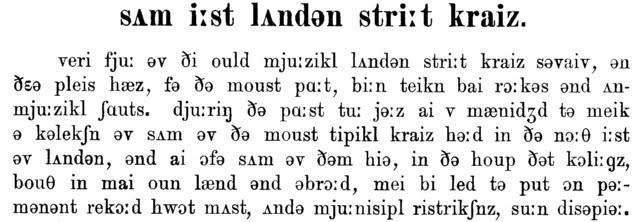
(The banner illustrating the Tagesschau article, reproduced above, has got its IPA symbols slightly confused. No one is at all likely to say nəˈvədə. The deprecated version is nəˈvɑdə, or with length marks nəˈvɑːdə.)

Reading further in the Politics Daily report, you can see that something deeper is involved than a run-of-the-mill disagreement over how to pronounce some ordinary vocabulary item. The pronunciation that most British people use, -ˈvɑːdə, is evidently perceived by Americans as “the Spanish pronunciation”.
Mortenson says he's not asking Nevadans to change. He just wants the Spanish pronunciation recognized.

This accords with the common but inaccurate identification by Americans of Spanish a with their own LOT vowel. (The British, in contrast, are perfectly happy to identify the Spanish vowel with English TRAP, as in Málaga, Spanish ˈmalaɣa, anglicized as ˈmæləɡə).
So what lies behind Mortenson’s proposal seems to be the deep-laid but irrational fear among many Americans that English is somehow being displaced by Spanish.

The Tagesschau article refers also to a number of German placenames whose spelling does not indicate the pronunciation unambiguously: Itzehoe, Coesfeld, Stralsund, Bleckede, Varel, Grevenbroich, Troisdorf and Poing, which are respectively ɪtsəˈhoː, ˈkoːsfɛlt, ˈʃtraːlzʊnt, ˈbleːkədə, ˈfaːrəl, ɡreːvn̩ˈbroːx, ˈtroːsdɔɐf, ˈpoːɪŋ — to which we might also add Duisburg ˈdyːsbʊɐk (blog, 29 July).

Monday, 23 August 2010

Barbados

I enjoyed the recent Society for Caribbean Linguistics biennial conference in Barbados.
Amongst other things, it offered plenty of opportunities to hear the locals talking. The Bajan (Barbadian) accent is rather easily distinguished from other kinds of Caribbean English. As I put it in AofE,
The most striking characteristics of Barbadian pronunciation, when compared with that of other parts of the West Indies, are full rhoticity, the use of a glottal allophone of /t/, and the quality of the PRICE vowel.

At first you might take Bajan nice nʌis for Canadian. But whereas the so-called Canadian Raising affects the PRICE vowel only in the context of a following fortis consonant (including a t that has undergone tapping/voicing, as in writer ˈrʌiɾɚ), Bajan PRICE is ʌi (or əi) in all phonetic contexts: child tʃʌil. Historically, it is presumably an archaism, a failure to lower the starting point rather than an innovation of raising it.
The Cockney-style glottal stop for t, on the other hand, seems to be an independent local innovation. I heard someone from a different part of the West Indies comment on the (to her) confusing way in which an announcement at the airport referred to flight AA 88 as ʔeː ʔeː ʔeːʔ ʔeːʔ.
Other West Indian accents are either non-rhotic or variably/partially rhotic. But the Bajans pronounce historical r in all positions. For English people, they sound a bit like people from the west of England. Combined with other features, this makes Bajan speech reminiscent of the popular stereotype of pirate talk.

I wonder why the name of the island, bɑːˈbeɪdɒs (or the like), is usually pronounced in BrE with a short vowel and voiceless fricative in the final syllable. In comparable words such as tornado, desperado, avocado, torpedo we pluralize in the usual way with z and retain long əʊ.

Unfortunately, IDEA hasn’t got any sound clips of Barbadian. Plenty of websites offer to tell you about Bajan dialect, including this one and this one. But none seem to have audio samples. Does anyone know where you can hear Bajan on-line? (You can, however, listen to local radio here.)

Friday, 6 August 2010

more mishearings

The silly season continues for Guardian letter writers. Here’s another one relating to the close NZ DRESS vowel, then Newcastle GOAT heard as NURSE. Then yet more NZ.

I think the last one goes too far, at least as far as Sally is concerned. You’d have to come from Glasgow or Belfast to mistake NZ TRAP for KIT.

But for a Londoner to mistake northern Irish SQUARE for NURSE is all too likely.
— — —
That’s it. There will now be a two-week break in this blog. Next posting: 23 August.

Meanwhile, to keep you entertained while I’m away, there’s more silly fun to be had from Jack Windsor Lewis and Karen Chung.

Thursday, 5 August 2010

yː in Wales?

Roy Becker-Kristal writes
The plot of the film Plots with a View takes place in Wales, in the fictional town of Wrottin Powys. Brenda Blethyn plays the main character, who speaks English with a Welsh-like non-rhotic accent.
Having watched the film a couple of times, I noticed that, in addition to the pronunciation of [ø:] in NURSE words, Brenda Blethyn pronounces NEAR words (here, beard) with [y:], with visible lip-rounding. On one occasion she also pronounces the word 'girl' as [gy:l] instead of [gø:l]. I should perhaps mention that her pronunciation of GOOSE words in this film is a relatively retracted [u:]. (Sorry I can't provide a link to a video that shows all this, you'll have to trust me.)
I haven’t seen the film, so can’t comment directly. In my Accents of English book I said (p. 381) that in south Wales
In NEAR words there is usually /jɜː/, so that beer /bjɜː/ can be said to rhyme with fur /fɜː/ as well as with fear /fjɜː/, while year, ear, and (/h/-dropped) here are all identical as /jɜː/. Some speakers, though use a disyllabic sequence /iːə/, thus beer /ˈbiːə/ etc.,, and in the environment _rV simple /iː/ is usual, thus period /ˈpiːriːəd/…
We know that NURSE is often rounded in southeast Wales, “giving the effect of a centralized raised [œː] or lowered [øː]” (p. 381), with an “auditorily unusual quality” (p. 383). So what one would expect for here is something like (h)jøː. If Brenda Blethyn really says (h)yː, this could be seen as a kind of coalescence in which two segments, j and øː, are collapsed into a single segment yː that shares the features of both.

Roy has another theory.
Suppose that Brenda Blethyn normally pronounces NURSE as a slightly advanced schwa, and NEAR with a slightly advanced high-central-unrounded monophthong (as many speakers of Estuary English do). These two vowels may actually form a vertical series for her. Then, as part of the effort to sound Welsh, she pronounces this series as front-rounded, thus correctly pronouncing [ø:] in NURSE but incorrectly pronouncing [y:] in NEAR.
Ingenious! Do we buy this?

(Blethyn is her married name. She was born Brenda Bottle in Ramsgate, Kent, and as far as I know has no Welsh connection beyond the surname of her ex-husband, which she retains as her professional name.)

Wednesday, 4 August 2010

cries of old London

The May–June 1910 issue of the m.f. (blog, 2 Aug) contains an unusual article by G. Noël-Armfield on the topic of London “street cries”.(I think the length mark at the end of the last word must be a mistake.)

You will see that a century ago Noël-Armfield was already bemoaning the decline in street cries. He was concerned chiefly with hawkers who walked the streets as they tried to sell their wares: his examples include sellers of coal, newspapers, watercress, milk, muffins, firewood and oysters. Apart from milk, which many Londoners still have delivered by a milkman, and coal, which no one uses any more, these are goods which you would nowadays buy in a supermarket. So nowadays there are no “cries” on the streets of London except possibly in the street markets. Even there I think market vendors at Portobello Road and Petticoat Lane are too sophisticated these days to shout their wares, though I suppose you might possibly find the odd stallholder at Brixton or Ridley Road calling out some special offer. And there are always the tricksters in Oxford Street.

Note the unexpected transcriptions kærəktristik and inʌnsjeiʃn (each with only four syllables). It’s interesting, too, to see ə in the endings -less and -ness, something DJ didn’t recognize for RP.

Noël-Armfield must be mistaken in his speculation that the glottal stop (“by no means uncommon … in the East End”) is due to German Jews. Apart from anything else, German/Yiddish glottal stop is initial (or as he would presumably have put it, “ʔim ʔanlɑut”), reinforcing a vowel, whereas the Cockney glottal stop is indeed typically medial or final and represents t.

At that time the Jews were the latest wave of immigrants in the East End. They were mainly from present-day Poland, Belarus or Ukraine rather than “German”, but of course Yiddish-speaking. A century later, their descendants have now moved out to Hendon or Chigwell and their place has been taken by the Bengalis and Somalis.

Noël-Armfield then launches into musical notation. I have space only for a small sample, covering the cries uttered by milkmen and chimney sweeps.
You’ll notice here another strange length mark in a NEAR word, ear-splitting in the last line. I wonder, too, whether “dʒenuin” is a mistake for the expected dʒenjuin, or whether it was intentional.

Noël-Armfield became Jones’s Assistant at UCL. He was the author of several books. One, called English Humour in Phonetic Transcript, you can view here. Another was General Phonetics for Missionaries and Students of Languages (read it here). Yet another was Un peu de rire français avec transcription phonétique, which I have never seen.

Tuesday, 3 August 2010

Guardian mishearings

Over the past ten days letter writers to the Guardian have been entertaining us with various mishearings and misunderstandings supposedly caused by regional/social pronunciation differences.

They all depend on phonetic overlap: where a sound [x], intended by the speaker as a token of lexical set /A/, is perceived by the hearer as representing the different lexical set /B/.

It started with crux (blog, 22 July) and the joke about a northerner in a hotel asking for a double rum and being offered not a drink but a room. Then...
So English pɜːnəʊ was heard as French pryno pruneaux. A northern monophthongal GOAT vowel was heard as a southern NORTH vowel.

…Geordie NURSE as non-Geordie NORTH; provincial FACE as Cockney FLEECE; and the problem that the sequence fʊks is taboo in the north of England but not in the south.
…southern STRUT heard as northern TRAP (take courage, Spanish and Japanese learners of EFL!).

…Ulster KIT (which can be very open) heard as LOT; New Zealand raised DRESS heard as non-NZ KIT (this is different from the corresponding American southern confusion, which operates only before a nasal).

…U-RP MOUTH heard as PRICE, and back to New Zealand DRESS heard as KIT……where TRAP is evidently getting so close nowadays that it can even be heard as FLEECE (or perhaps rather just as DRESS, with an unusual pronunciation of semen).

Monday, 2 August 2010

125 years

It’s 125 years since the International Phonetic Association was founded. I have been looking at my copy of its journal, lə mɛːtrə fɔnetik, for 1910. A century ago the Association’s quarter-centenary was celebrated in the form of an artiklə də fɔ̃ by Paul Passy entitled œ̃ kaːr də sjɛkl (‘A Quarter of a Century’). In it he records — in phonetically transcribed French — the Association’s “immense success” in the reform of language teaching, the development of phonetic research, and (in third place) the popularization of phonetic notation (la vylɡarizɑːsjɔ̃ d l ekrityːr fɔnetik).

Daniel Jones was to marry Passy’s niece Cyrille the following year, in 1911.

Meanwhile in 1910 we read [At the University of London, starting on the tenth of October, D. Jones will deliver a whole series of phonetics courses for various categories of student (English Phonetics, French Phonetics, Old English, Old French, Experimental Phonetics). These courses will end with three examinations, on English phonetics for foreigners, French phonetics, and English phonetics for the English.]

There’s an enthusiastic paragraph from DJ himself on the subject of Atkinson’s Mouth Measurer. This was before he became disillusioned with experimental phonetics. Mr Atkinson’s invention was later rendered obsolete by the development of x-ray imaging. It’s interesting to see that the overseas price is given with the then standard orthographic abbreviations for shillings (s.) and pence (d.). You’d think Jones might have written “8ʃ. 6p.”. Or even “eit n sikspəns”.