Friday, 30 April 2010

recently...

The standard descriptions of English phonetics really fall down — it seems to me — when it comes to the sequence involving a voiceless plosive preceded by a nasal and followed by a lateral, such as we have in recently.
Reading Gimson’s Introduction, even in Cruttenden’s latest revision (the seventh, 2008: §9.2.4 The Release Stage of English Plosives, (5) Lateral release, p. 167), you would imagine that in such a case we always get lateral release of an alveolar plosive, i.e. ˈriːsntlli. True, there’s also a section in the book headed ‘Glottal replacement in RP’ (§9.2.8 (c), p. 180), but it contains no examples of a plosive preceded by a nasal. (To be fair, neither does the panel on Glottal Stop in LPD.)
There are people who do indeed have a laterally released alveolar plosive, just as described. I do myself, in relatively formal or careful speech. But I also have another option, as I think most people do.
This is to have a glottal stop between the sonorants: ˈriːsnʔli. Listening to the party leaders debating on television last night, I was struck by the fact that not only the Scotsman (Brown) but also both of the privately educated Englishmen (Clegg and Cameron) used this variant, in this word and even more strikingly in importantly ɪmˈpɔːʔnʔli.
Actually, though, just labelling the segment a glottal stop does not tell the whole story. Once the tongue tip has made contact with the alveolar ridge for the n segment in recently, it retains the contact until the end of the l segment. What we have for the plosive between them (in the variant I’m discussing) is a double articulation, alveolar and glottal. You can tell there’s glottal closure as well as alveolar from the absence of the typical burst noise of lateral release as we move on to the lateral. The glottal closure is the more important of the two closures, since once the air stream is dammed by the closed glottis it is not available to build up pressure behind the alveolar closure, hence no noise of lateral release. If you find it helpful to have a phonetic symbol for every allophone, you could write this one [t͡ʔ] (t and ʔ joined by a tie bar).
It is not even clear that the double plosive has nasal approach. At the end of the n segment the airstream may well be cut off not so much by the rising soft palate as by the coming together of the vocal folds. Perhaps the /t/ in recently has neither nasal approach nor lateral release.
I think this is the usual pronunciation of /t/ in this phonetic environment in AmE, too.

Thursday, 29 April 2010

re-

Dear Professsor Wells,
I’m confused about the pronunciation of the prefix re-. When does it have the DRESS vowel? LPD says “if stressed through the operation of a stressing rule”, but I don’t understand what that means.
XYZ

Let’s try to set out the facts about this prefix using a different approach.

1. When re- means ‘again’, it is pronounced ri: and stressed. So we have for example reapply, renegotiate, reconsider, all with ˌriː-. In words such as refit, rethink, rerun we get the familiar stress difference between verb and noun, but the first part is always riː. A ˈrefit, but to ˌreˈfit. So far, the rule is easy.

2. When re- has a vaguer meaning, it usually gets weakened and is unstressed. We have ri- or rə- (it doesn’t matter which) in words like remember, retain, remarkable, repeat. This rule is easy, too. However, if the sound immediately after the re- is a vowel, then we always have ri- (= riː- or rɪ or something intermediate). The only important example is react riˈækt and its derivatives.

3. Now we come to the tricky bit. If re- has the vague meaning AND IS STRESSED, AND IS FOLLOWED BY A CONSONANT SOUND, then it is pronounced re-. This type includes several well-known words: relative ˈrelətɪv, recognize, reference, relevance, and also for example recompense, replicate, resonate. (Compare relate, refer, where the re- is unstressed and weak.)

4. If the main stress is on the syllable after the syllable after the re- (= two syllables later), we normally get secondary stress on the re-, which therefore has a strong vowel, which again is e. So we have for example reclamation ˌrekləˈmeɪʃən (compare the verb reclaim with weak re-), recognition, recommend ˌrekəˈmend, recreation, reformation, relativity, reparation, repetition, replication, reprehensible, represent, reservation, resignation, restoration.
Types 3 and 4 are therefore the words I mean when I say “if stressed…”. They are the ones that present the greatest problem for learners of EFL.

5. This being English, some words are irregular and exceptional. For example, many people pronounce one or all of relaxation, resistivity, retardation in a way that violates the above rules.

6. These principles also apply to de- and pre-. Examples: 1. deconstruct, predetermine; preprint; 2. decide, prepare; 3. deference, preference; 4. dereliction, preparation; 5. AmE treats premature as having the explicit meaning ‘before’ (ˌpriː-); BrE treats it as having the vague meaning (ˌpre-).

Sorry, it’s still pretty complicated.

Wednesday, 28 April 2010

ən ɪnˈɔrgjərəl ˈlɛktʃər?

For years I had been teaching people that speakers of rhotic accents pronounce an r sound wherever there is a letter r in the spelling, and not where there isn’t. Non-rhotic speakers on the other hand — which includes me and most of the students I lectured to at UCL — don’t, since we have lost /r/ except before vowel sounds.
I would illustrate this with pairs such as court–caught, larva–lava, sore–saw, career–Korea, tuber–tuba, manner–manna, western–Weston — and dear–idea.
Then I started to notice that sometimes I would hear rhotic speakers who nevertheless seemed to be pronouncing r at the end of idea. How could this be? Anyhow, I had to start expressing myself rather less sweepingly, more circumspectly. Some words (not only colonel) seemed to be exceptions. They had no <r> but they did have [r] for some rhotic speakers. (See also my blog for 11 October 2007, and Accents of English vol. 2 p. 343.)

(We non-rhotics do sometimes say aɪˈdɪər, of course, but only before vowels: that’s our “intrusive r”, ðə ˈveri aɪˈdɪər əv ɪt. But that’s a quite different matter.)

Now the Scottish (and correspondingly rhotic) phonetician Jim Scobbie has revealed the shocking facts. He reports that he has an “extra” r in the items Chicago, unauthorised, theatre, idea and, as he has just noticed, in inaugural.

There is no historical r at the relevant point in these words. The explanation is presumably false analogy in words first heard pronounced by nonrhotic speakers. If a Scot hears an English person say ˈɔːɡən organ and knows that it corresponds to Scottish ˈɔrɡən, it’s entirely understandable that he would infer that for English English ɪnˈɔːɡjʊrəl the corresponding Scottish form must be ɪnˈɔrɡjərəl. Spelling doesn’t come into it.

In rhotic accents outside Britain, where the influence of England’s non-rhoticity is weaker — in America, in Canada, even in Ireland — you would expect this sort of thing to be less likely to happen.

Tuesday, 27 April 2010

creating a vowel diagram

Gwen Awbery writes
I have a longstanding problem trying to get hold of a blank, basic vowel chart which would be compatible with OpenOffice or similar, and to which I could add vowel symbols as required. Is there such a resource lurking out there somewhere in cyberspace? It seems likely, but I haven't been able to locate one. I would be very grateful for any advice on this.

I did a Google search for “blank vowel chart”, which threw up this file from Wikimedia commons.
Once you’ve saved a copy of the blank diagram to your own computer, the next question is how to add vowel symbols to it. Presumably you need to use some kind of graphics program. I succeeded in adding the symbol æ, using the Photostudio software that came bundled with my printer (which is what I use for scanning, cropping and resizing the assorted illustrations that accompany my blog). See above.
However, many graphics programs, including this one, seem to have trouble with Unicode text. Although I haven’t spent long on this, I have not so far succeeded in superimposing vowel symbols such as ɛ, ɔ, ʊ, ɑ̃.
I haven’t tried the Draw program that comes with OpenOffice.

Can someone with greater experience of graphics software offer Gwen (and the rest of us) some advice?
How do Wikipedians achieve results like the chart of AmE vowels I found here?


PS: inspired by Gerald Kelly (see comments below), here’s one I have just made in Powerpoint. To convert the result into a jpg I took a screenshot (Alt-PrtScrn) and then cropped and resized it with Photostudio.
PPS: further inspired, this time by David Crosbie, here’s one made in Word for Windows Vista.
Thanks to all.

Monday, 26 April 2010

implicational or not?

In the trailer for a television programme yesterday the voiceover invited us to join the presenter on
what’s con\/sidered to be | one of the ˈfinest ˈwalks in \Britain.

…which led me to reflect on an ambiguity in the meaning of the English fall-rise tone.
The voiceover actor, overemphasizing things as actors tend to, caused me at first to misinterpret the intonational meaning as ‘considered to be one of the finest (but actually not one of the finest)’. That is, I took the tone to be an “implicational” fall-rise (my English Intonation – an Introduction, §2.6–7).
I realized immediately that that didn’t make pragmatic sense. What was intended was merely a dependent fall-rise (§2.20), indicating only that we have not yet reached the end of the sentence, that there is more to come.
If I had had to read the voiceover script, I think I would have removed the ambiguity by saying just
what’s considered to be one of the ˈfinest ˈwalks in \Britain.
— with no accent at all on considered. But it would also have been unambiguous to use a non-nuclear accent on considered:
what’s conˈsidered to be (ˈ)one of the ˈfinest ˈwalks in \Britain.
— though, depending on speech rate, this might produce an uncomfortably long intonational phrase.
It may be the case that the falling-rising pitch movement tends to be wider in an implicational fall-rise than in a dependent one (or for that matter than in a “tentative” one). That would explain why the actor’s animatedness led to my initial misinterpretation of his meaning: he produced a fall-rise so wide that its primary meaning would be the implicational one. I would suspect that the wider the pitch range, the more likely a fall-rise is to be interpreted as implicational, and the narrower, the more likely to be interpreted as dependent. But it might conceivably also depend on the absolute pitches used.
Does anyone know of any evidence showing whether or not pitch and meaning in the fall-rise are linked in this way?

Friday, 23 April 2010

Pygmalion Cameron


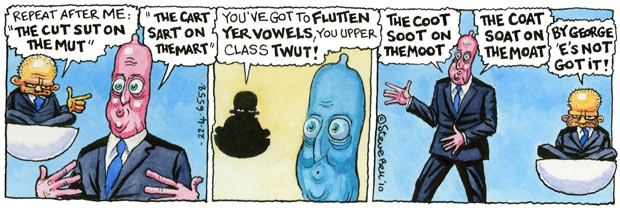
This political cartoon from yesterday’s Guardian (click to enlarge) may be pretty opaque to non-Brits today and will be opaque to everyone in fifty years’ time. It is a comment on the supposed unsuccessful attempts by the leader of the Conservative party, David Cameron, to make himself sound less upper-class (blog, 8 April) in preparation for face-to-face television debates with the leaders of the other two main parties.
The cartoon is an obvious allusion to the characters Professor Higgins and Eliza Doolittle in Pygmalion / My Fair Lady (“By George, she’s got it!”).
The cartoonist shows Cameron with a condom for a head, for reasons I can no longer remember.
The hovering Mekon figure (readers of the 1950s Eagle comic will know what I mean) is William Hague, former leader of the party, definitely not upper-class, and notable for having retained an unreconstructed Yorkshire accent and therefore using a “flat” vowel in TRAP words (= an open and retracted [a], like the vowel of RP STRUT).

Thursday, 22 April 2010

proven

I don’t know enough about the history of our spelling to be able to explain with certainty the oddity of having the letter o correspond to the pronunciation in the words move (and remove) and prove (approve, improve, reprove), but I assume we have to blame those Norman clerks who didn’t like to write u next to the then identical v. Awareness of the etymology may have played a part, too, given that these verbs come from Latin movēre, probāre.
Despite the spelling–pronunciation anomaly, there is no tendency at all to regularize the position by adopting a spelling pronunciation. No one says məʊv instead of muːv, or prəʊv instead of pruːv.
But people in Britain do quite often say ˈprəʊvən rather than the expected ˈpruːvən for proven. This is one of the two possible past participles of prove, alongside proved. To some extent it has taken on a life of its own as a prenominal adjective (as when we say “a proven track record”, though never “a proved track record”).
The variant ˈprəʊvən seems to be quite recent. It is not mentioned in EPD prior to Roach’s editorship. Unless someone can prove the contrary, I shall tentatively claim that LPD was the first dictionary to include it, just twenty years ago.
According to OBGP, it is particularly associated with the Scottish legal verdict not proven. Is this true, and if so, why?