skip to main |
skip to sidebar
kɪdɪŋ ɔː nɒt, ɪf ə kɒmənteɪtər ɒn fraɪdiz blɒɡ kleɪmz tu əv hæd dɪfɪkl̩ti prəʊsesɪŋ ðə hedlaɪn ðen ɪts haɪ taɪm wi hæd ənʌðər entri rɪtn̩ həʊlli ɪn fənetɪk trænskrɪpʃn̩. (ðə lɑːs sʌtʃ entri ɪn ðɪs blɒɡ wəz ɪn dʒuːn.)
 lɑːs naɪt aɪ pleɪd maɪ mələʊdiən ət ə seʃn̩ ɪn ə pʌb ɒn wɪmbl̩dən kɒmən, nɒt veri fɑː frəm weər aɪ lɪv. ðiːz seʃn̩z ə held wʌns ə mʌnθ ən ɔːɡənaɪzd baɪ ə ləʊkl̩ mɒrɪs saɪd.
dʒʌst ʌndə twenti piːpl̩ tɜːnd ʌp fə ðə seʃn̩. ðeɪ ɪŋkluːdɪd θriː ʌðə mələʊdiən pleɪəz. ɪts ɔːlwɪz ɪntrəstɪŋ tə kəmpeə nəʊts. bifɔː wi stɑːtɪd, wʌn əv ðəm kaɪndli əlaʊd mi tə traɪ aʊt hɪz ɪnstrəmənt (mʌtʃ mɔːr ɪkspensɪv ðəm maɪn).
evriwʌn wəz siːtɪd əraʊnd teɪbl̩z ɪn ə smɔːl rʊm ɪn ðə pʌb (ðə snʌɡ). wʌns ðə seʃn̩ prɒpə wəz ʌndə weɪ, ðə fɔːmən (tʃeəmən) kɔːld ɒn iːtʃ pɑːtɪsɪpənt ɪn tɜːn tə liːd ə tjuːn ɔːr ə sɒŋ. ðə prəʊɡræm wəz ə mɪkstʃər əv ɪnstrəmentl̩ stʌf (fɪdl̩z, kɒnsətiːnə, maʊθ ɔːɡən, mələʊdiənz) ənd ʌnəkʌmpənid sɪŋɪŋ. tuː ruːlz əplaɪd, əz ɪz juːʒuəl ɪn pʌb seʃn̩z — nəʊ æmplɪfɪkeɪʃn̩ ən nəʊ pleɪɪŋ ɔː sɪŋɪŋ frəm ə rɪtn̩ skɔː.
ðə sɪŋəz sæŋ veəriəs fəʊk sɒŋz ən fəʊk-staɪl sɒŋz. wiː ɪnstrəmentl̩ɪss pleɪd ɪŋɡlɪʃ (ənd ʌðə) dɑːns tjuːnz. ðiːz ə tɪpɪkli θɜːti tuː bɑː riːlz, dʒɪɡz, hɔːnpaɪps ɔː wɔːltsɪz, wɪð ðə strʌktʃər AABB. ðə kənvenʃn̩ ɪz ðət ju pleɪ iːtʃ tjuːn θriː taɪmz θruː, ɡɪvɪŋ ʌðə pleɪəz taɪm tə pɪk ʌp ðə melədi ən dʒɔɪn ɪn ɪf ðeɪ kæn.
maɪ əʊn fɜːs kɒntrɪbjuːʃn̩ wəz ə raʊdi riːl kɔːld tʃaɪniːz breɪkdaʊn (Chinese Breakdown), wɪtʃ tə maɪ səpraɪz ði ʌðə pleɪəz dɪdn̩t nəʊ — ɪt wəz wʌn əv ðə steɪpl̩z əv ðə bænd aɪ juːs tə pleɪ ɪn fɔːti jɪəz əɡəʊ — fɒləʊb baɪ ðə krʊkɪd stəʊvpaɪp (Crooked Stovepipe). leɪtə, wem maɪ tɜːn keɪm raʊnd əɡen, aɪ pleɪd dʒesiz hɔːnpaɪp (Jessie’s Hornpipe), seɡweɪɪŋ ɪntə səʊldʒəz dʒɔɪ (Soldier’s Joy), wɪtʃ evriwʌn nəʊz.
In the talk on Multicultural London English that I recently gave in Japan, one of the things I mentioned was a tendency to simplify the phonetics of the indefinite and definite articles by reducing their allomorphic variation. My data came from Kerswill et al., ‘Contact, the feature pool and the speech community: The emergence of Multicultural London English’, Journal of Sociolinguistics 15/2, 2011: 151–196. I am well aware that MLE speakers are not the first NSs to fail to observe the rules that we teach EFL students for the pronunciation of the (that is, ðə before a consonant sound, ði in front of a vowel sound, plus the occasional strong form ðiː). Indeed, I make the point in the note I put in the relevant entry in LPD.
What seems to be true is that ðə plus hard attack before a word beginning with a vowel sound is more frequently heard in MLE than in, say, traditional Cockney or RP. But this is only an impression: I don’t think we have much in the way of hard statistical evidence. The sociolinguists may know its percentage incidence in MLE (see table below), but there’s not a lot of information available about other varieties.  I don’t think I ever say ðə ˈʔæpl̩ and so on myself. But I could be wrong.
 At the age of 18, as I was picking up German by staying with a family in northern Germany on a family exchange, I noticed that when wanting to know the time my exchange partner, rather than ask Wie viel Uhr ist es? (‘how many o’clock is it?’), as shown in my tourist’s phrasebook, would usually go for the formula Wie spät ist es? (‘how late is it?’). So I did so too.
Imitating his pronunciation, I pronounced spät as ʃpeːt, using the same vowel sound as in Wie geht’s viː ˈɡeːts ‘how’s it going?’.
As I got to grips with the written as well as the spoken language, I learnt to treat the umlauted letter ä as being pronounced exactly the same as the letter e.
Years later, when I studied phonetics with John Trim at Cambridge, he told me that the German pronunciation I had acquired through total immersion, while commendably native-like in its way, was in some respects regional. If I wanted to speak proper Hochdeutsch, I ought to remember to say Guten Tag! with taːk, not ta(ː)x; the train, der Zug, should be tsuːk, not tsʊx; and for long ä, as in spät, I ought to add a new item to my German vowel system, namely the long ɛː, thus ʃpɛːt.
The standard set out in German dictionaries and textbooks treats orthographic e and ä as having the same value when short, ɛ, but different values when long, namely eː and ɛː respectively.
So fällen ‘to fell’ ˈfɛlən is a perfect rhyme for bellen ‘to bark’ ˈbɛlən (both have the short vowel). But wählen ‘to choose’ should not, in Hochdeutsch, be a perfect rhyme for fehlen ‘to be lacking’ (with the the long vowel): ˈvɛːlən, ˈfeːlən.
This distinction still feels artificial to me, and I don’t make it unless perhaps carefully reading some text aloud or making a phonetic point.
The pronunciation dictionaries tend to hedge their bets on this distinction. Here’s the sixth edition of the Duden Aussprachewörterbuch. Der Vokal [ɛː] kann auch [eː] gesprochen werden… (p. 21: ‘The vowel [ɛː] can also be pronounced [eː]…’)
And here’s the Deutsches Aussprachewörterbuch. Der Unterschied zwischen [eː] und [ɛː] wird in der Aussprache meist nich stark verdeutlicht, so dass häufig ein Vokalklang zwischen [eː] und [ɛː] mit einer Tendenz zu [eː] entsteht. (p. 58: ‘The difference between [eː] and [ɛː] is for the most part not made very clearly in pronunciation, so that frequently a vowel quality between [eː] and [ɛː] arises, with a tendency towards [eː].’)
Wikipedia says, I think quite correctly, The long open-mid front unrounded vowel [ɛː] is merged with the close-mid front unrounded vowel [eː] in many varieties of Standard German…
I shall continue to speak German with an undifferentiated eː.

One or two of the people commenting on nt-reduction (blog, 18 Nov.) also mentioned the possibility of twenty having the vowel ʌ.
Kensuke Nanjo said According to my daily observation of American English, I think this variant is worth including in pronouncing dictionaries. Quite a few Americans use it and as you may know, this is the second variant for "twenty" in the Merriam-Webster Collegiate Dictionary.
 There are indeed plenty (“plunny”?) of Americans who seem to pronounce twenty with a seriously backed and lowered quality as compared with their default DRESS vowel.
However, in deciding whether this is a sporadic irregularity found just in this word (and perhaps in plenty too), we must first establish what is their default DRESS vowel. We need to discount the possible effects of what, following Labov, has come to be known as the Northern Cities Vowel Shift.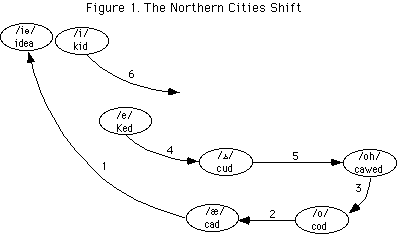
The “northern cities” (of America) in which this sound change flourishes are clustered around the Great Lakes: places such as Buffalo, Cleveland, Detroit, and Chicago. The geographical extent of the shift varies depending on which vowel is involved and in which phonetic environment(s); and in any case it is also socially and stylistically variable. But what it can do is to make DRESS words sound as if they have the STRUT vowel — perhaps all of them, perhaps particularly those in which the vowel is followed by a nasal. Note that the STRUT vowel shifts too, so that we do not normally get loss of the distinctions exemplified in get – gut, bed – bud, wren – run etc.
So someone who says ˈtwɛ̈ni, with a thoroughly retracted vowel, is not necessarily saying ˈtwʌni (“twunny”), to rhyme with funny.
Others, though, are. They include rirelan, who mentioned twenty: /ˈtwʌni/ (along with "plenty" /ˈplʌni/. "plentiful" is still /ˈplɛntəfəl/ though.)
Furthermore, Americans from other, mainly southern or western, parts of the country may merge pen and pin as pɪn (i.e. merge DRESS with KIT before a nasal). For them, twenty may rhyme, if not with funny, then with skinny as well as with many.
Kensuke reckons that a reasonably exhaustive pronunciation dictionary ought to give AmE twenty as ˈtwenti, ˈtwʌnti, ˈtweni, ˈtwʌni. Seems reasonable, though perhaps we ought to add ˈtwɪnti, ˈtwɪni, too.
 The egregious Sepp Blatter, president of FIFA, tried to defuse the impact of his recent inept remarks on tackling racism by getting the newspapers to print a picture of him in the company of Tokyo Sexwale, the black South African politician.
But how do we pronounce Mr Sexwale’s name? Certainly not ˈseksweɪl.
If you search on-line, you find no authoritative answer and several conflicting pieces of advice from amateurs.
An exchange on reddit went
● Spoiler: Tokyo Sexwale is not pronounced the way it's spelled.
● Yup. As my South African-parented girlfriend immediately pointed out, it's "Seh-tongueclick-wah-leh."
and then● The 'x' in the Sex part is pronounced like a soft 'g' in afrikaans.
Meanwhile the online Telegraph told us firmly Tokyo Sexwale (pronounced seh-wa-le)…
This is one of the names I decided to add to the most recent edition of LPD, so I actually checked it out a few years ago (blog, 3 July 2007).
My initial expectation was that the letter x in his name would stand for the voiceless lateral click, as it does in Xhosa and Zulu, where xoxa ‘tell’ is pronounced ˈǁɔːǁá (or, if you prefer greater explicitness in click symbolism, ˈk͡ǁɔːk͡ǁá).
However, my further researches seemed to suggest that Mr Sexwale’s ethnicity is not Xhosa or Zulu but Venda (or Venḓa — the diacritic indicates a dental, as opposed to alveolar, place of articulation). And in Tshivenḓa the letter x has its IPA value, representing a voiceless velar fricative. So he’d be seˈxwaːle.
The BBC Pronunciation Unit confirmed this. Yes, the IPA for our entry [for Sexwale] indicates a velar fricative. The recommendation is based on the advice of colleagues in Focus on Africa, who, according to our history note from 1993, were adamant that the orthographic 'x' is pronounced as a velar fricative.
(That is indeed also how the orthographic g of Afrikaans is pronounced.)
Conclusion: in English we should call him seˈxwɑːleɪ or, failing that, seˈkwɑːleɪ.
On Friday I said Maybe I’ve just not been keeping my eyes open, but I can’t recall reading any surveys of the prevalence or otherwise of what I would like to call nt-reduction.
 One resource I overlooked has now been brought to my attention by Kensuke Nanjo, phonetics editor of the Genius English-Japanese Dictionary, Fourth Edition (2006), in a long email which is worth quoting in extenso. He claims that this “G4” is
the only dictionary that distinguishes [nd] (t-voicing) and [n] (t-deletion) for underlying /nt/ in American English. G4 gives [nd] for carpenter, certainty, into, ninety, seventy, Washington as their second variant in American English while it shows variants without /t/ for other /nt/-words like center, dental, Internet, plenty, twenty, winter, etc. with the label "casual AmE".
Kensuke says that the decisions he made were
based on some books and papers that I'd read and personal communications with American phoneticians, perhaps including the late Becky Dauer, but I'm afraid I don't very well remember where I obtained the data. This distinction ([nd] vs. [n] for /nt/), however, is mentioned in the phonetics/phonology chapter I wrote for the book Ando & Sawada (eds.) English Linguistics: An Introduction (2001), so I obtained the data more than a decade ago.
He further comments
You rightly mention that "it does not happen in the environment of a following stressed vowel, as in intend, contain", but both LPD and G4 record /nt/-reduction for Antarctic, perhaps as a sole (?) exception.
— probably because of the transparent morphology which makes ant#arctic seem like a compound comparable to print#out, in which nt-reducers do reduce nt.
He continues Also, I agree with your comment that "[it doesn't] apply to ntr clusters, as in country. The t can be lost in centre/center but not in central", but G4 gives the variants like "inner"-duce and "inner"-duction for introduce and introduction respectively, with the label "casual AmE". This is based on my own daily observation about American English. Needless to say, this is a case of r-to-schwa metathesis, which triggers /nt/-reduction. In fact, I tried to include as many cases of common metathesis as possible in G4, so it gives the American casual pronunciation "hunnerd" for hundred, a case of both r-to-schwa metathesis and lexically restricted /nd/-reduction (e.g. can'idate, fun'amen'al, kin'a, un'erstand, won'erful).
These nd-reductions of casual speech are very relevant, too. Thanks, Kensuke.
Maybe I’ve just not been keeping my eyes open, but I can’t recall reading any surveys of the prevalence or otherwise of what I would like to call nt-reduction. By this I mean the loss of t from the cluster nt in intervocalic contexts. This makes winter a possible homophone of winner,
painting a possible rhyme of straining and dental a potential rhyme of kennel. As far as I know this is not found in any kind of British speech, and we think of it as an American or Australian characteristic.
The possible AmE pronunciation of continental as ˌkɑ̃ːʔn̩ˈẽnl̩ is quite strikingly different from the BrE ˌkɒntɪˈnentl̩.
Several qualifications are needed.
• In the kind of AmE I am referring to, winter may possibly have a nasalized tap, thus ˈwɪɾ̃ɚ, rather than the more deliberate plain nasal of winner ˈwɪnɚ. Trager and Smith (1951) refer to this as a ‘flap-release short nasal’, how accurately I am not sure. In any case, a distinction based solely on ɾ̃ vs. n cannot be very robust. I suspect that in reality for many Americans (and Australians) winter and winner can be, and often are, pronounced identically.
• I have the impression that the incidence of nt-reduction is subject to regional variation in the US. It seems more prevalent in the south and west, less so in the north-east. Is this so? Do Canadians ever do it? It is also probably subject to stylistic variation, with unreduced nt more careful and the reduced variant more casual. Has anyone ever investigated its sociolinguistic characteristics?
• The environments in which nt-reduction operates seem to be the same as those for t-voicing. In particular, it does not happen in the environment of a following stressed vowel, as in intend, contain, nor of a following unstressed but strong vowel as in intake; nor does it apply to ntr clusters, as in country. The t can be lost in centre/center but not in central.
• Some words may be special cases, In particular, I have the impression that ninety in AmE is often ˈnaɪndi rather than the expected ˈnaɪnti or ˈnaɪni. Does the same apply to seventy? Are there other exceptional cases?
• Special cases of a different kind are the handful of words in which a similar reduction is found in BrE, namely in London and some other kinds of popular English. For Brits who do this, the t can be lost from twenty and plenty, and from prevocalic went and want (as in went out, wanted), but not from words such as winter or painting.
This posting was triggered by my hearing an Australian golf commentator on TV referring to ðə ˌsevn̩ˈiːnθ the seventeenth (hole). This violates the constraint barring nt-reduction before a stressed vowel, and I suspect would not be possible in AmE.
Furthermore, I wonder whether Australian English has taken nt-reduction direct from AmE, rather than via some British source? And if so, is it the first instance of such a sound change?
 lɑːs naɪt aɪ pleɪd maɪ mələʊdiən ət ə seʃn̩ ɪn ə pʌb ɒn wɪmbl̩dən kɒmən, nɒt veri fɑː frəm weər aɪ lɪv. ðiːz seʃn̩z ə held wʌns ə mʌnθ ən ɔːɡənaɪzd baɪ ə ləʊkl̩ mɒrɪs saɪd.





 Posts
Posts

