skip to main |
skip to sidebar
 On BBC Radio 4 there is a panel game called The Unbelievable Truth. In it, panellists have to speak on a given topic. What they say consists mostly of lies, but with a few nuggets of truth hidden among the rubbish. The other panellists have to try to detect the truths.
Last Monday’s episode, repeated yesterday, had one of the panellists talking on the subject of Cake. One of the purportedly true assertions he made was that the word cookie comes from the Dutch word… well, he said something like ˈkɜːkdʒi. The chair, David Mitchell, later repeated this as something like ˈkœːkjə.

They were both no doubt reading from a script that spelt the Dutch word correctly as koekje. As my readers will of course know, in Dutch this is actually pronounced ˈkukjə, making it a very plausible source for the English word.
What I find shocking is that the first panellist didn’t know that Dutch j is pronounced like English y (as in German, Danish, Polish etc., not to mention IPA); and that neither he nor the chairman knew that the Dutch spelling oe regularly corresponds to the sound u. (Facts about Dutch phonetics here.) It’s like in English shoe and canoe!
All BBC producers and other contributors have access to the excellent BBC Pronunciation Unit, which is staffed by knowledgeable trained phoneticians who know about, or can find out about, any language you care to mention. They are a phone call or a mouse click away. But they won’t tell you unless you ask.
But hey, there are only 22 million or so speakers of Dutch, even if they do live just a few hundred kilometres away (almost as far away from London as Scotland!). Educated people can’t be expected to know the basic facts about such an unimportant language. Particularly in a country where foreign language study has been virtually dropped from the secondary school curriculum.
 One of the songs our choir is practising for our Christmas show is I wonder as I wander, which is a “traditional Appalachian carol” or, according to another account, was “written in 1933 by John Jacob Niles from a fragment of a song he heard sung during an evangelical church fundraising meeting”.
I notice that our singers find it quite difficult to pronounce the two verbs accurately. They sometimes seem to sing aɪ ˈwɒndər æz aɪ ˈwɒndə. I even caught myself doing it when not concentrating properly. Here’s a fragment of our tenor 2 rehearsal track that we use for practice: see what I mean.
Presumably we all agree that I wonder (how Jesus the Saviour did come for to die) should have the STRUT vowel, thus ˈwʌndə (or perhaps the Appalachian equivalent ˈwəndɚ); while I wander (under the sky) should have the LOT vowel, ˈwɒndə (or ˈwɑndɚ).
Or are there people who pronounce the two words as homophones? Some subset of the English people who have ɒ in one and among? Or do some people neutralize the two vowels in the context of a preceding w?
Failing that, I think the difficulty may be due to the difficulty of parsing and understanding the phrase I wonder as I wander out of context and of identifying the appropriate word from the spelling in each case.
Wonder is one of those words in which the STRUT vowel is spelt o instead of the more usual u (compare under, thunder, asunder, which rhyme with it), while wander is one of those words in which the LOT vowel is spelt a instead of o (compare ponder, yonder).
Confusing.
 Thanks to everyone who commented on yesterday’s posting.
I don’t apologize for trying to devise “rules” for selecting an appropriate intonation pattern. They are exactly what typical NNS postgraduate students of phonetics need when faced with the task of marking up intonation on a written dialogue. Furthermore, without rules of the kind I offer they tend to suggest some very implausible patterns. NS students, on the other hand, know intuitively what will do and what won’t, but they can’t explain why. If I pair a NS and a NNS in class, we have the blind leading the blind — until they have some rules.
It’s all very well saying (I quote Glen Gordon) a language is best learned in an intuitive way with free exploration, personal experimentation, encouragement of careful listening, contemplation, etc.
—but faced with a group of Japanese postgraduates who have been learning English for over ten years (often without, let’s be honest, enormous success) you need to offer them something more tangible.
Equally, when Glen writesSo when somebody suggests to have a drink, one says "There's a thought" with emphasis on the deictic to convey that this immediate suggestion is exceptional (compared to all other thoughts by anyone at any time). Likewise "That's a good dog" implies that a particular dog is more than just good; he's exceptionally so in comparison to the average dog.
—my reaction is that this is no doubt reasonable, but it doesn’t help. My students will immediately ask WHY the speaker would want to convey that the suggestion is exceptional (because it isn’t, really), and WHY the speaker feels it necessary to say that his dog is “more than just good”. Fine if you do the same thing in your L1; not helpful if you don’t.
Let’s go on with yesterday’s problem of how to supply the NNS learner with rules to generate an acceptable intonation pattern. Back to the dog.
\There’s a clever dog!
This is what you might typically say to your dog when he has successfully learned some new task or trick. (For certainty, I have made a quick-and-dirty video recording demonstrating the pattern I am referring to. Apologies for the domestic background.)
Consider the matter logically. Your utterance contains two apparently new lexical items, clever and dog. It also contains a demonstrative, and demonstratives behave like lexical items in that they are by default accented — as mentioned in §3.11 of my book. So in this exclamation there are three likely accents, there’s, clever, dog. We know that the nucleus goes by default on the last of them, which is dog.
However, both you and the dog know that he is a dog. (We have to assume that the dog knows — or perhaps we just have to approach things anthropomorphically.) So you can argue that dog is given, not new. That leaves clever as the last accentable word.
Is clever new? Yes, it’s the whole point of what you’re saying. You’re congratulating the dog on being clever. A “logical” accentuation pattern would therefore be There’s a \clever dog.
But that is not what we say. Strangely, we deaccent clever, even though it might appear to be the most important word. Idiomatically (?), we place the nucleus instead on the demonstrative.
(Oddly enough, it would be fine to say something likeYou’re a \clever little dog, | \aren’t you?
It’s also fine to say
ˈWhat a ˈclever \dog!
So with different wording you can express much the same meaning with the intonation nucleus somewhere else. There’s no general principle that renders clever and dog unaccentable.)
You could construct some kind of post-hoc justification for placing the nucleus on there’s. The dog training we are engaged in has the purpose of making the dog clever. Therefore both dog and clever are given by context. Therefore the nucleus has to go somewhere else, and there’s is the only other possibility.
\/Clever | \dog!
/Who’s a clever dog?
\You’re a clever dog!
\This is a clever dog!
\There’s a clever dog!
But be honest: would you have come up with this pattern just by following the rules? No, you need your NS intuition, or to be a speaker of an L1 that does the same thing, or at least to be familiar with what is idiomatic in English.
That was ˈone ˈclever \dog!
You ˈsee the \/problem.
 Imagine you’re a non-native speaker. You want to perform a dialogue that includes this exchange:
A: Let’s have another drink.
B: Now there’s a thought!
You want to decide on an appropriate intonation pattern for what B says. You apply the rules: locate the nucleus on the last new lexical item, unless there is a reason such as contrastive focus for it to go somewhere else.
You conclude that the nucleus should go on thought, which is actually the only lexical item available. You come up with
B: Now there’s a \thought.
Moreover, you might logically expect there’s to be weakened, and say
B: (ˈ)naʊ ðəz ə \θɔːt
Unfortunately, any native speaker will be able to tell you that this pattern is impossible in this context (or at best highly unlikely). What we would actually get in real life is
B: naʊ \ðeəz ə θɔːt
or possibly, though in my view less probably,
B: naʊ \ðeəz | ə /θɔːt
A nuclear accent goes on the demonstrative there’s. (The meaning of the whole is also idiomatic: something like “What a good idea!”.)
Cases such as this, where the typical NS pattern doesn’t result from the intonation rules we teach NNS learners, are in my analysis intonational idioms. I am always interested in collecting instances of such idioms. In my book (English Intonation, CUP 2006, page 172, or in the Japanese translation page 256) I give a number of examples similar to this one, with a nucleus idiomatically placed on a demonstrative (that or there).
What’s ˈthat supposed to mean?
You can say \that again!
\There’s a clever dog!
It explains nothing simply to claim that the speaker chooses to emphasize the demonstrative, treating the deixis as especially important (or some such wording).
My ideal is to supply EFL learners with an algorithm that enables them to predict with confidence an appropriate spoken intonation pattern for any written fragment of dialogue. Where I fail in this ambition, I may need to refine my rules. Failing that, I call the pattern idiomatic.
 The main UK commercial TV station, ITV, is currently in the midst of a major weekly costume drama series, Downton Abbey, set in the England of a hundred years ago.
In this week’s episode the upper-class family who live in the big house, after the death of the heir in the Titanic disaster, are struggling with the fact that the new heir to the property, a rather distant relative, seems be insufferably upper-middle class. Not quite one of us. The chap prefers to dress himself instead of using the services of his valet! Doesn’t hunt! Clearly a bounder.
One of the devices the playwright (Julian Fellowes) deploys to let the family demonstrate its upper-class values is having them discuss Greek mythology over the dinner table. (But the new master passes the test, by being able to join in intelligently.)
Without exception the actors pronounce Perseus as ˈpɜːsiəs and Cepheus as ˈsiːfiəs. I can’t help feeling that this is wrong for the period. Even when I did classics at school half a century later they were without hesitation ˈpɜːsjuːs and ˈsiːfjuːs. The same applies to all other Greek names in -ευς -eus: Zeus, Theseus, Aegeus. Historically, I think, this is because this ending was monosyllabic in Greek, with a diphthong, rather than a disyllabic with a vowel sequence. To compose Greek verse (as we did at school) it is extremely important to know the exact number of syllables in every word, so you had to get this right.
Today’s actors, for all their other undoubted skills in reproducing the upper-class speech of a century ago, never had to compose Greek verse and do not know this; and no one has told them.
Footnote: in Greek, Perseus appears not only as Περσεύς (two syllables) but also as Περσέας Perséas (three syllables). I don’t know why English chose the former variant as the source of the name; but in any case it’s irrelevant to the mores of the upper class in 1912.
As I brush the egg off my face, I agree I’d better stick more strictly to phonetics.
 Today’s blog will be derivative. First, here’s a cutting-edge report from the world of phonotectonics and consonantal drift.
Second, we have a video of a young Londoner doing rather impressive impressions of twenty different accents. This video went viral over the weekend, so you may have seen it already.
 I thought that was pretty good on the whole, though the attempt at a Japanese accent is feeble. And he needs a scriptwriter. You may consider his “natural” speech, his own accent, rather interesting, too. Despite his extensive use of intervocalic t-glottalling and th-fronting, he does not think of it as Cockney. On the contrary, the very first “impression” he attempts is one of Cockney. It differs from his usual speech by, for example, incorporating shifted diphthongs and by a marked change of voice quality.
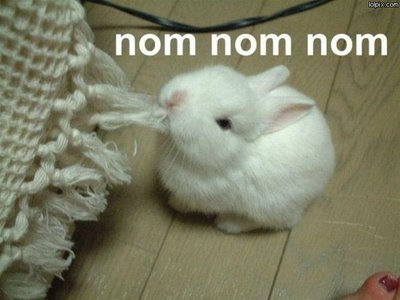
Thirdly, a footnote to Friday’s nom nom nom.
 Aficionados of lolcats and the icanhascheezburger site will be familiar with cats’ (and other animals’) propensity to go “nom nom nom” and their love of nomming.
This word is unknown to the OED, but the invaluable on-line Urban Dictionary tells us — at some length and with a lot of repetition — that a nom is the sound one makes when eating something, and that to nom is to eat.
(Just search for nom in Google Images to see hundreds of examples.)
What, I wonder, could be the etymology of this term?
In Jamaican (and other Caribbean) Creoles there is a word nyam, which can be a noun meaning ‘food’ or a verb meaning ‘to eat (particularly in a crude manner)’. The word has now made it to the OED, which summarizes its probable etymology as
a West African language (e.g. Wolof ɲam to eat or Fula ɲama to eat), although perhaps simply imitative.
Here is the beginning of the more detailed treatment available in Cassidy & Le Page’s Dictionary of Jamaican English (CUP, second edition 1980).

Although foreign-language a is mapped onto the TRAP vowel in British and Caribbean English, in AmE it could well be mapped onto the LOT vowel. (Compare BrE kebab kɪˈbæb, in AmE also kabob, from Arabic etc. kabāb.) The non-English initial palatal nasal ɲ might well have been replaced by the familiar n. Hence a source form ɲam might have become AmE nɑm, which would naturally be spelt nom.

I haven’t got access here to a word list of Gullah (or indeed of AAVE) to check for n(y)am, n(y)om there, but perhaps one of my readers has. If found, that might clinch the matter.
In short, I wonder if nom is a doublet of nyam and is thereby one of the rather few words of English taken from an African language. Or is it really “simply imitative”?
 On BBC Radio 4 there is a panel game called The Unbelievable Truth. In it, panellists have to speak on a given topic. What they say consists mostly of lies, but with a few nuggets of truth hidden among the rubbish. The other panellists have to try to detect the truths.







 Posts
Posts

