skip to main |
skip to sidebar
 Another not-me pronunciation from our bouncy new local TV newsreader (blog, 13 October): she pronounces St Paul’s Cathedral as ˈseɪnt pɔːlz kəˈθiːdrəl. (What I would say myself, of course, is sənt ˈpɔːlz kəˈθiːdrəl. The first word, St, could also undergo one or more of syllabic consonant formation, glottalling, elision and assimilation, to give sn̩ʔ, sn̩, sm̩p, sm̩ʔ, sm̩.)
Traditionally we regard the use of the weak form of Saint in names as more or less categorical in BrE. Obviously it is much less usual in AmE. But in BrE this seems to be changing: I keep hearing Brits using the strong form. I’ve heard Seɪnt Albans, Seɪnt-Leonards-on-Sea, Seɪnt George’s Hospital, though never yet as far as I am aware Seɪnt Helens (in Lancashire). Perhaps there is something special about Lancashire: I don’t think I’ve heard Lytham St Annes with strong seɪnt, either.
Personally, I weaken saint not only in all the names just cited but also in the names of all those West Indian islands, too, though I know the locals don’t: St Martin, St Thomas, St Barts, St Kitts, St Croix, St Lucia, St Vincent.
 The only saintly island I can think of in which I wouldn’t use the weak form is St Helena, in the south Atlantic. But it has the idiosyncratic pronunciation ˌsentɪˈliːnə (or variants thereof — the author of the relevant Wikipedia article doesn’t know this). On the other hand I’d call the lady herself sənt ˈhelənə, and I believe the place in California is ˌseɪnt (h)ɪˈliːnə. (What do Australians do with the place in Victoria? It’s supposedly named after the Atlantic island.)
And you’ll know about the idiosyncrasies of the surnames St Clair/Sinclair ˈsɪŋkleə, St John ˈsɪndʒən, and St Leger ˈselɪndʒə, as well as of Gilbert & Sullivan’s reference to the London street St Mary Axe ˌsɪməriˈæks in the song about someone with a name very similar to my own.
 Exceptionally, contrastive intonation can sometimes lead us to accent a syllable that has no lexical (underlying) stress.
It ˈwasn’t exactly \/green, | but it ˈwas green\ish.
Indeed, this particular suffix sometimes gets treated as if it were an independent word.
A: Are you ready?
B: Ish. (= more or less)
There are other suffixes that firmly resist contrastive stressing.
A: You stole it!
B: I didn’t!
Logically, in this second example, you might expect B to accent the n’t part of didn’t. Indeed, it is possible to switch to the unweakened form of not and say I did not, placing the accent on not. This seems to happen regularly in Irish English, but in English English I think we generally prefer just to stick with didn’t, keeping the accent (illogically) on the did part.
B: aɪ ˈdɪdn̩t
What, then, do we do if we read aloud the following, which I came across in Richard Dawkins’ The Greatest Show on Earth? I retain the author’s italicization.
Even though it is not easy for human chemists to predict what change in protein shape will result from a particular genetic mutation, it is still a fact that once a mutation has occurred, the resulting change of protein shape will be in principle predictable.
Would you say that last word as pridɪktˈəbl̩? Or what?
Equally, I don’t see any easy way to accent the nonsyllabic suffix in
It’s not “corn” beef, it’s corned beef.
Perhaps kɔːnˈdə? No, I think you just have to slow down and articulate kɔːnd extremely clearly.
 Being the son of an anglican priest, I have always been familiar with the word sojourn, the biblical term for making an overnight or temporary stay in a place.
 And there was a famine in the land: and Abram went down into Egypt to sojourn there; for the famine was grievous in the land.
Israel also came into Egypt; and Jacob sojourned in the land of Ham.
Since it’s a word I’ve always known, I’ve never hesitated about its pronunciation, which for me is ˈsɒdʒən (automatically implying ˈsɒdʒn̩ as an alternative).
Daniel Jones, while recognizing ˈsɒdʒən as a possibility, nevertheless preferred ˈsɒdʒɜːn, with a strong vowel in the second syllable. He also allows ˈsʌdʒ- for the first syllable. Meanwhile AmE tends to prefer soʊˈdʒɝːn, ˈsoʊdʒɝːn, sometimes with a stress difference between noun and verb.
For many people this is no doubt a word which — if they know it at all — they know only or mainly in its written form, so it is not surprising that the pronunciation is nowadays rather uncertain.
I wonder if anyone has r in the first syllable. Probably not. According to the OED, until the sixteenth century it was sometimes spelt with r. This may reflect the second of the two possible Latin sources, subdiurnāre and superdiurnāre.
 Thanks to Flloyd Kennedy for drawing attention to this Australian cabaret turn, in which Andrew Hansen pokes fun at the way Julia Gillard, the Australian PM, pronounces the word negotiate.
Where most people say nɪˈɡəʊʃieɪt, Ms Gillard says nɪˈɡəʊsieɪt (or with Australian vowels more precisely nəˈɡʌʊsiʌɪt).
In LPD I give both possibilities, prioritizing ʃ. EPD, ODP and the OED do the same. The Oxford Concise gives only ʃ. I think we would probably all agree that the s form has overtones of exaggerated formality, perhaps prissiness. In some cases I suspect it may also be a spelling pronunciation.
For the other words mentioned by Andrew Hansen, in LPD I prioritize ʃ in every case, giving the s variant for appreciate and substantiate, but not for propitiate, initiate or differentiate.
Everyone has ʃ in ocean, never s; but in oceanic some do have s. Most people have ʃ in the middle of species ˈspiːʃiːz, but in speciation -si- is perhaps commoner than -ʃi-. So stress has something to do with it.
(And by the way why does pronunciation have -si- rather than -ʃi-?).
I’m not sure that I can unravel all the historic and synchronic factors involved here.
 The eyes of the world have been on the dramatic and inspiring mine rescue in Chile.
It has been very gratifying to see the BBC deploying Spanish-speaking reporters able to interview the miners and rescuers in Spanish while translating the questions and answers into English as they do so. Let’s hope that this not only does something to rescue us from our reputation of being unable to speak foreign languages but also demonstrates to today’s young people the value of learning languages.
Not all reporters and not all TV channels managed to get the names right. The name of the second man out was Sepúlveda, Spanish seˈpulβeða, properly anglicized as sɪˈpʊlvɪdə; but I kept hearing him referred to as ˌsepl̩ˈveɪdə. The name Acuña, Spanish aˈkuɲa, got its tilde ignored as it became English əˈkuːnə, and Esteban, Spanish esˈteβan, ehˈteβan, was misstressed as ˈestəbæn.
There is also an issue with the name of the country. The traditional English pronunciation of Chile is ˈtʃɪli, homophonous with chilly and chil(l)i (pepper). That was the only pronunciation known to Daniel Jones for BrE and to Kenyon and Knott (1944) for AmE. But in Spanish it’s ˈtʃile, and in recent years the revised anglicization ˈtʃɪleɪ has come increasingly into use, at least in AmE. That was how President Obama pronounced it in his message of support.
And what about the corresponding adjective? Traditionally Chilean has always been ˈtʃɪliən. But now some people have started saying tʃɪˈleɪən. I’m not sure why this should be: no other words in -ean are treated in that way (think of Shakespearean and c(a)esarean on the one hand, European on the other hand, and variable Caribbean on both). Spanish chileño offers no support.
 Our choirmaster makes us warm up in the usual way by performing various singing exercises. One thing we have to do is to get ourselves to concentrate properly on what we are doing (“move into the zone”), for which we have to sing tongue twisters. In one of them, we repeat the words red lorry, yellow lorry at speed up the scale, then orange lorry, yellow lorry back down the scale. It’s remarkably difficult to get it right.
If native speakers find it tricky, think of what the Japanese would make of it.
You can sympathize with the Americans, who call it a ‘truck’ rather than a ‘lorry’.
I wonder why the 80s rock band Red Lorry Yellow Lorry chose a tongue twister as their name.
* * *
 I know it’s a sign of old age to complain about the ignorance of the young, but there you are. Today’s complaint concerns a bouncy new ITV newsreader presenting the local news for the London area, who doesn’t know how to pronounce Godalming, a town of 21,000 people about 50 km (30 miles) from London. No, it’s not “ɡɒˈdælmɪŋ”, it’s ˈɡɒdl̩mɪŋ. How can you be a Londoner, a professional newsreader, and not know that? Must be one of those people who never venture south of the river.
As I lay in bed this morning, listening half-asleep to the parliamentary report on the radio with a discussion of the coming cuts in welfare payments, I was jerked awake by the realization that the expressions child benefit and housing benefit have different stress patterns.
The reporter talked about possible reductions in child BENefit, and then later about the question of HOUSing benefit. I realized that these stressings agree with my own intuitions on how to stress these particular compounds. And there’s no logic in it.
It’s very important when discussing the stressing of compounds to disregard two well-known effects that can cause the default (lexical) pattern to be overridden: (i) contrastive stress and (ii) stress shift.
For anyone who shares my intuitions about the two kinds of benefit, contrastive stress would nevertheless lead us to say, for example,
They get not only HOUSing benefit but also CHILD benefit.
She works in local government for the HOUSing department. Her job involves the determination of housing BENefits.
—both of which go against the default pattern.
Similarly, just as we have AFTernoon TEA, FIFteen PEOPle and TOWN Hall STEPS (despite afterNOON, fifTEEN, and Town HALL), we might say
There are going to be severe CHILD benefit reDUCtions.
Having got those two disturbing factors out of the way, I am left with the conclusion that as dictionary entries I would give ˌchild ˈbenefit but ˈhousing ˌbenefit. I have no idea how widely these patterns would be agreed to by other speakers of BrE, and I wonder what non-Brits unfamiliar with these expressions would say.
The stressing of compound nouns is a notorious difficulty for EFL. Although the basic rule is clear (the main stress goes on the first element of a compound), there are not only several well-established classes of exceptions (e.g. if the first element names a place, time, material, or ingredient), but there is also a long tail of cases where all one can say is that there is no firmly established pattern. We can coin new compounds on the fly (or indeed recoin compounds of whose existence we are unaware), and it may be impossible to determine whether or not there is some implicit contrast involved or what you would say in a contrast-free context. Meanwhile we have some well-known sets of illogicalities.

I’ve sent her a BIRTHday card.
She bought me a BIRTHday present.
Here’s some birthday chamPAGNE for you!
I’ve written him a birthday TRIBute.
I quite often get emails from NNS EFL teachers asking me for the stress pattern of this or that compound not listed in dictionaries. I may supply an answer, but I would be less than honest if I claimed to be always entirely certain whether it was the correct answer. For example, Martín Capell wrote Could you please tell me whether I should say FAmily MEMber or FAmily member. In other words, is this compound single- or double-stressed?
I replied I don't think there's any fixed pattern. On the whole I’d go for “family MEMber”.
Other NSs might disagree.
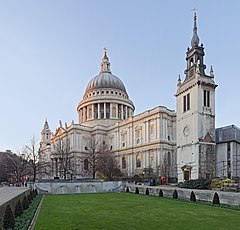 Another not-me pronunciation from our bouncy new local TV newsreader (blog, 13 October): she pronounces St Paul’s Cathedral as ˈseɪnt pɔːlz kəˈθiːdrəl. (What I would say myself, of course, is sənt ˈpɔːlz kəˈθiːdrəl. The first word, St, could also undergo one or more of syllabic consonant formation, glottalling, elision and assimilation, to give sn̩ʔ, sn̩, sm̩p, sm̩ʔ, sm̩.)
 The only saintly island I can think of in which I wouldn’t use the weak form is St Helena, in the south Atlantic. But it has the idiosyncratic pronunciation ˌsentɪˈliːnə (or variants thereof — the author of the relevant Wikipedia article doesn’t know this). On the other hand I’d call the lady herself sənt ˈhelənə, and I believe the place in California is ˌseɪnt (h)ɪˈliːnə. (What do Australians do with the place in Victoria? It’s supposedly named after the Atlantic island.)







 Posts
Posts

