Friday, 31 August 2012

supercilious in Penge

I have been browsing through the second edition of A Dictionary of London Place-Names by A.D. Mills, newly published in paperback by OUP.

One of the things that Mills points out is that apart from various river names (Lee or Lea, Brent), the only London name of Celtic origin is Penge, the SE20 suburb, which is derived from a Celtic/British/Old Welsh compound corresponding to modern Welsh pen ‘head’ plus coed ‘trees, wood’, exactly as in Pencoed in south Wales, literally ‘Woodhead’.

He comments further

Some make mock of Penge (an unusual name but not a pretentious place) by pronouncing it superciliously to rhyme with ‘blancmange’.

That is, they jocularly call it not pendʒ but pɒndʒ.

I have a friend who lives in Fulham ˈfʊləm. Sometimes in jest he similarly refers to it as flɑːm.

Another whimsical or jocular pronunciation distortion of this type is found in Liverpool, where the name of the district of Blundellsands ˌblʌndl̩ˈsændz (or in the local Scouse accent ˌblʊndl̩ˈsandz) is sometimes converted into the posher-sounding ˌblʌndl̩ˈsɑːndz, as if the final syllable belonged to the BATH lexical set (compare Alexander, commands and Ed’s recent comments about Castleford.)

Mills tell us that the etymology of Fulham is the rather boring ‘river-bend of a man called *Fulla’. In the Domesday Book (1086) it was spelt Fuleham, but in the Anglo-Saxon Chronicle (c. 900) Fullanhamme, with an OE genitive case ending -n on the personal name.

The street name Piccadilly has, Mills tells us, ‘rather a bizarre’ origin.

It seems that the name first appears as Pickadilly Hall in 1623, otherwise Pickadel Hall in 1636, as a (no doubt humorous) nickname for a house belonging to one Robert Baker, a successful tailor who had made his fortune from the sale of piccadills or pickadillies, a term used for various kinds of collars, highly fashionable at the time, for both men and women.

EFL teachers can use ˌpɪkəˈdɪli as a convenient demonstration of the ‘stress shift’ effect when we come to Piccadilly Circus ˌpɪkədɪli ˈsɜːkəs.

Thursday, 30 August 2012

tap, tap

Alexis Contreras writes from Mexico with what at first sight is a simple and straightforward question.
I have been trying to figure out something about the alveolar flap or tap. I'm not sure whether the Spanish r as in words like "pero", "cero", "caro" and the like is the same as the English sound in words and phrases like "matter", "natalie", "order", "water", "how to" "about a" and the like. At first I thought the sounds were the same. But then I started to do some research and began doubting whether or not they were the same sounds. I began leaning towards them not being the same. But right now I'm in doubt again. I think they might be the same, but I'm still not sure. […] Could you please tell me if there is any articulatory difference between the two sounds or not?

In saying "English", Alexis is of course referring only to AmE. The usual BrE consonant in the middle of water ˈwɔːtə is very different from the Spanish single /r/ in pero ˈpeɾo. This BrE t is voiceless, slow, perhaps somewhat aspirated and indeed often affricated, whereas Spanish ɾ is voiced, and rapid. But in AmE, on the other hand. the etymological t in the words quoted is a voiced tap (‘flap’, say some) that is indeed very similar to the Spanish /r/, and is indeed sometimes transcribed identically, as ɾ.

Are the two sounds merely similar, or are they ‘the same’? Partly the problem is one of asking what we mean when we say that two sounds are ‘the same’. Do we just mean that language learners can safely treat them as equivalent? Or is it deeper than that?

Not all Spanish ɾ are identical. For example, some speakers articulate it with the tongue tip against the teeth, making it dental; but for others it may rather be alveolar. The duration of the closure is usually about 20 ms, but may on occasion be somewhat longer or shorter. The AmE sound is at least as variable, and probably more so. For example, it may not always be fully voiced (particularly for those relatively few Americans who consistently distinguish pairs such as shutter and shudder). Following the NURSE vowel, as in dirty, it may involve a ballistic movement, a true flap, in which the active articulator strikes the passive articulator and continues in the same trajectory, as opposed to the more usual type in which the active articulator ‘bounces off’ the passive, involving an up-then-down movement. In Natalie, battle etc, the tap is unlike anything in Spanish, since it has lateral release. (But some speakers use a glottal stop here rather than a tap. A glottal stop is equally un-Spanish.)

More importantly, perhaps, the tongue configuration before and after the consonant may differ considerably in the two languages, giving rise to different formant transitions in the on-glide and off-glide of the segment we are discussing.

The clincher comes, though, from x-ray tracings. I reproduce this from Ladefoged and Maddieson’s The Sounds of the World’s Languages (Blackwell 1996).

The authors comment

The English speaker has a preparatory raising and retraction of the tongue tip during the preceding vowel […] The tongue is then moved forward to make the contact which is captured in the frame illustrated here, after which it returns to the floor of the mouth. The Spanish tap does not involve any substantial anticipation, but instead has a quick upward and downward movement confined to the tongue tip.

It is possible that in the case of water, the word illustrated here, the preparatory retraction of the tongue tip may be in anticipation of the r-coloured ɚ which follows. Would we find the same retraction in a word such as atom ˈæɾəm? I do not know.

So what is my answer to Alexis? I think we can say that the two sounds are not really exactly identical, but that for language learning purposes we can treat them as if they were.

Wednesday, 29 August 2012

the poet and the phonetician

Commenting on yesterday’s blog, Ed said
Some working-class people have the idea that a schwa [in certain places] is lazy and that "posh people" don't use them [but they do, in fact]. Believe it or not, I've come across people who think that you're supposed to say Garforth with final /fɔ:θ/ and Castleford with final /fɔ:d/. I wonder if some announcers have grown up with this idea of correct speech and that it's coming into BBC English now.

Truly, there’s nothing new under the sun.

Just over a hundred years ago, in 1910, Daniel Jones, then just setting out on his career as a phonetician and not yet widely known, was forcefully attacked by Robert Bridges, the recently appointed Poet Laureate and a founder member of the Society for Pure English.

Bridges was much exercised about standards of pronunciation. As Collins and Mees put it (The Real Professor Higgins, Mouton 1999, ch. 4.11)

Bridges believed sincerely that the pronunciation of English was gravely threatened by declining standards, and was therefore determined to fight to restore it to what he considered to be its proper state.

In Bridges’ view, its proper state was one that closely reflected the orthography. He was particularly concerned with what he termed “the degradation of the unaccented vowels” — by which he meant the use of ə in unstressed syllables.

Quoting Jones’s Phonetic Transcriptions of English Prose (Oxford, 1907), Bridges apostrophizes the reader as follows.

Now please observe, most gracious reader, that this is not a dream nor a joke. It shows the actual present condition of things, as formulated by an expert, promulgated by the University of Oxford, and recommender ter foreigners. Foreigners are really being taught that the pronunciation of to (tŭ), which is hundreds of years old, is now changed to ter (tə), and that in our “careful conversation” we say ter and inter for to and into.

Mountain and cabbage ought, of course, in Bridges’ view, to be pronounced with eɪ in the final syllable. Ambulance ought to have -æns. The poet continues

The only question can be whether Mr. Jones exaggerates the actual prevalence of degradation. Some will acquit him of any exaggeration. Others I know very well will regard him as a half-witted faddist, beneath serious notice, who should be left to perish in his vain imaginings.

’Vain imaginings’ is a peculiarly inappropriate characterization of Jones’s carefully observed and accurately reported descriptions of the educated pronunciation of his day.

Jones, by the way, reports that Bridges

didn’t speak with his reformed pronunciation; his pronunciation was very much like mine, except that he made rather freer use of the obscure vowel to which he took such strong objection.

In 1926 Bridges was appointed Chairman of the BBC’s Advisory Committee on Spoken English. Jones, by then Professor of Phonetics in the University of London, was one of its members.

Tuesday, 28 August 2012

Isaac

I’ve heard one or two news presenters referring to the tropical storm/hurricane now threatening parts of the US as ˈaɪzæk. But Isaac is of course usually pronounced ˈaɪzək, with the vowel in the second syllable reduced. (Some may reduce it to ɪ instead of ə, as also happens adjacent to the velars in accept and stomach).

Another biblical name in which orthographic aa corresponds to a spoken weak vowel is Canaan ˈkeɪnən. For variants of this latter name, see my blog, 6 March 2009. Although we may sometimes have ˈkeɪniən I don’t think we ever get *ˈaɪziək, although you might logically expect that we would.

Another, non-biblical, name currently in the news is that of the Russian-American author Ayn Rand. I first came across her Atlas Shrugged when I was an undergraduate. Appalled at her advocacy of selfishness and contempt for altruism, I was not a fan. In those days we gave her first name a spelling pronunciation, eɪn. I note that nowadays people are pronouncing her aɪn, like the German indefinite article or the letter of the Arabic alphabet. Indeed, this is what is given in the Oxford BBC Guide to Pronunciation and in Merriam-Webster’s Collegiate, not to mention Wikipedia. Since her given name was Alisa (Алиса), it is not clear where Ayn comes from, or whether it is English or Russian. Presumably it is a Russian hypocoristic.

Monday, 27 August 2012

close

The guilty verdict and the sentence passed on Anders Breivik, thought the Norwegian commentator interviewed on Sky News, would hopefully bring the whole matter to a kləʊs.

We native speakers of English, though, hope (if we do) that it will bring it to a kləʊz.

The pronunciation of the various words spelt close is remarkably difficult for the spelling-based learner of EFL — even for those who, unlike Scandinavians and speakers of Spanish, have no difficulty with the s – z opposition and who, unlike Germans and Russians, are not tempted to devoice all word-final obstruents.

The verb to close, meaning to shut, has z, and closed, antonym of open, accordingly has zd. Likewise closing and the 3sg (he) closes, both with -z-. The noun used by the commentator is the deverbative form of the same, which is why it too has z.

Quite different is the adjective close meaning adjacent or near. It has final s, as do its comparative, superlative and adverbial derivatives closer, closest, closely.

Strangely enough we have another, rather infrequent noun, one that is prounounced like the adjective, i.e. with s. It means ‘an enclosed place, an enclosure’ (OED), and in contemporary English (BrE only) is restricted to (i) the area and buildings surrounding a cathedral and (ii) proper names, including the surname Close (for example, R.A. Close, author of A Reference Grammar for Students of English) and the names of certain dead-end streets. This is what is appropriate for Sir Henry Newbolt’s poem

There’s a breathless hush in the close to-night —
Ten to make and the match to win —
A bumping pitch and a blinding light,
An hour to play and the last man in.

Teachers will be familiar with another word, homophonous with the verb to close but spelt differently, namely cloze. It refers to a kind of reading test in which someone has to supply missing words deliberately omitted from a passage. This word appears to have been coined by W.L. Taylor in the 1950s, and is supposedly based on closure (which, nevertheless, normally has ʒ).

A quick test for NNSs: pronounce correctly close your eyes; hold me close; they’re close friends; too close for comfort; a close shave; a close (sic!) vowel; a close run thing; to sail close to the wind; behind closed doors; drawing to a close, the close season (AmE the closed season).

Next up: when is supposed pronounced with z(d), and when with s(t)?

Friday, 24 August 2012

breathiness

The August 2012 issue of the Journal of the International Phonetic Association contains, as usual, several interesting and informative items.

The lead article, by Christina Esposito and Sameer ud Dowla Khan, concerns contrastive breathiness in consonants and vowels. Various languages have contrastive breathiness on voiced obstruents, as in the case of Hindi bʰ etc.; some have contrastive breathiness on semivowels or vowels, as in Zulu j̤e̤ɓo ‘yes’ (my example, not the authors’). A very few languages have both contrastive breathy-voiced vowels and breathy-voiced aspirated consonants, including the Gujarati and White Hmong that the authors here analyse. Since both involve breathy voicing during the vowel, the crucial question is, how is the CʰV type distinguished from the CV̤ type?

The authors studied Gujarati minimal triplets such as ba̤ɾ ‘outside’, bʰar ‘burden’, baɾ ‘twelve’, and White Hmong triplets such as da̤ ‘lie, fool’, dʰa ‘separate’, da ‘yellow’ (these are also tonally distinct). They found that in both languages consonantal breathiness is initially breathier than vowel breathiness. The timing of the breathiness also differs, being later for vowel breathiness than for consonant breathiness. (I summarize.)

Thursday, 23 August 2012

family words

I expect most families have private, family words, used only within the family and never with outsiders.

When I was growing up, we certainly did. And special family (mis)pronunciations, too. I’m not thinking just of nursery words for excretion and body parts, though of course we had those.

For example, my father and brothers and I (though perhaps not my mother) would often pronounce jug as jʌɡ (“yug”) and jump as jʌmp. My father would tell me to get a ˈjʌɡ əv ˈɒlɪndʒ (jug of orange (squash)) to put on the table for a meal. Whether this betrayed some paternal or precocious filial awareness of IPA and historical phonology (confusion of liquids) I do not know.

We also sometimes called ice cream ɪˈkekriæm, obviously in a playful misinterpretation of the spelling.

Our dog was called Carlo, but we sometimes called him Doggus ˈdɒɡəs instead, so recruiting him to the Latin second declension masculine. (We had all started Latin at a pretty tender age.)

Interestingly, when my German exchange friend Klaus came to stay with us at the end of my stay with his family when I was eighteen, I remember that he misinterpreted this name as Doggers ˈdɒɡəz, which would put it in line with champers ‘champagne’, Johnners (Brian Johnstone the cricket commentator) and the Staggers (the New Statesman periodical).

_ _ _

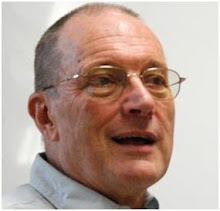
I'm glad to see that the UCL summer course maintains the tradition of using nonsense words for ear-training. Here's Geoff Lindsey (photo: Masaki Taniguchi).