Thursday, 9 July 2009

sloths

Everyone knows that some English nouns ending in f have an irregular plural in which the f changes to v: leaf – leaves, wife – wives, shelf – shelves. Everyone knows this because the spelling changes. (Under the heading of “everyone” I suppose we must exclude certain Scottish people, since if I am not mistaken in Scotland the plural of wife is often wʌɪfs.)
Not so many people are aware that there are several nouns in θ and one in s that exhibit the same alternation, namely the change from a voiceless fricative to a voiced one before the plural ending is added. Thus we have mouth – mouths, truth – truths, house – houses. Hah! the spelling doesn’t show this. But it’s there in the pronunciation: maʊθ – maʊðz, truːθ – truːðz, haʊs – ˈhaʊzɪz.
There are also plenty of nouns ending in a voiceless fricative that behave regularly: cliffs, graphs, coughs; faiths, deaths, osteopaths — and all the remaining nouns in s plus all of those in ʃ (buses, kisses, rushes, dashes).
The list of those that switch voicing is closed: new coinages or borrowings behave regularly. The list of nouns in th that exhibit the alternation is quite short: baths, oaths, paths, sheaths, truths, wreaths, youths, and even with these there are some speakers who treat one or more of them regularly.
At least — I thought the list was closed. But on the BBC R4 programme Home Planet this week I heard a science writer several times pronounce sloths as sləʊðz. (This animal name was touched on in this blog a few days ago.)
You may still be able to listen to the programme here.

Wednesday, 8 July 2009

phonetics for the layman

It’s depressing that some writers of foreign language textbooks have so little knowledge of phonetics. They don’t know how to teach pronunciation (except by imitation). They don’t have the understanding to describe speech sounds. They don’t have the vocabulary to explain how sounds are made.
So when they come to write textbooks they can’t give clear explanations of how to pronounce the language.
The Guardian is publishing a series of Spanish phrasebooks this week. At the back there is a Pronunciation guide. Put yourself in the position of a naïve would-be learner of Spanish, and see how much help it offers.

What kind of sound would you take a less forceful ‘d’ to be? A fricative, perhaps, or an approximant? Or a very lenis plosive with no voicing? No, that’s the description the booklet gives of the Spanish single r — which is actually a pretty forceful tap, [ɾ].

Fortunately there is a supporting audio CD available (at a price). But if the author devotes a page in the phrasebook to pronunciation it ought to give accurate and helpful advice.

If you have even a very elementary knowledge of Spanish phonetics, you’ll know that the voiced plosives /b d g/ have weakened allophones [β ð ɣ] intervocalically and finally. The Guardian booklet tells us nothing about this for the dental and velar.
You’d think it would at least have mentioned that the d in nada sounds much more like the th (ð) in English father than it does like English d. I would have thought this more important than telling us about Argentinian variants of ll.
Q: If the plosive-fricative alternation in /d/ and /g/ is not worth mentioning, why does the author mention it for /b/? A: Because that’s where the spelling forces it on everyone’s attention. But what does he say? that v and b are “like b in bath, but softer and slightly aspirated”.
Oh dear, oh dear. Here we have a phonetic technical term, aspirated. It’s just that the author doesn’t understand its meaning. For the record, no plosives in Spanish are aspirated (= with an interval of voicelessness between the plosive release and the following segment).
In fairness, I must report that the author, when I remonstrated with him, told me
I can't remember now whether that definition was borrowed from another source or if it was my own specific attempt to describe the bilabial fricative in layman's terms, but it's a fair point about the misappropriation of a technical term...
I suppose I could defend the position by saying it was a non-technical usage (consonant with the rest of the guide), but on the other hand I'd certainly avoid it if I was doing the guide again.

Let me try to explain the facts as I understand them in terms that the ordinary reader might be able to understand.
In Castilian Spanish, the letters b and v refer to the same sound.
At the beginning of a phrase or after m or n this sound is just like an English b. (So vaso sounds like “BAH-so”, and enviar is “em-bee-AHR”.) Elsewhere it is pronounced like an English v, except that you use the two lips rather than the lower lip and the upper teeth.

For a language learner with some phonetic training, it’s easier. All we need say is
Initially or after a nasal /b d g/ are plosives, [b d ɡ]. Elsewhere they are realized as fricatives, [β ð ɣ] (or the corresponding approximants).

Contrary to the impression you may have formed from the above, I cannot actually speak Spanish, because I have never learnt it. But I certainly know how to pronounce it. And I know how to teach other people how to pronounce it. Oughtn’t this to be part of the intellectual equipment of all teachers of Spanish?

Tuesday, 7 July 2009

rowlocking fun

What is the AmE pron of rowlock? In a sense there isn’t one, because the Americans call the object in question an oarlock.
In BrE, where we do use the word rowlock, those who are familiar with rowing and oarsmanship call it a ˈrɒlək (or possibly ˈrʌlək). Those who are not may instead use a spelling pronunciation ˈrəʊlɒk (compare forehead, where the spelling pronunciation has largely displaced the traditional ˈfɒrɪd).
LDOCE ascribes the spelling pronunciation only to AmE:
row•lock /ˈrɒlək $ ˈroʊ-/ n [C] BrE one of the U-shaped pieces of metal that holds the OARS of a rowing boat

In LPD I proceeded on the assumption that any American rowers who actually needed to use the British term would use a BrE-style pronunciation.

In a trivial way, the same sort of question arises if we ask what the BrE pronunciation of rowboat is. In a sense there isn’t one, because in BrE it is called a rowing boat.
But we have to draw a line somewhere: no one wants to say that in AmE trousers is pronounced pænts.

Monday, 6 July 2009

heavy metal Brüno

David Marsh, the Guardian style guide editor (and, I’m proud to say, my former student), had a nice piece in the paper a few days ago about umlauts.
Sacha Baron Cohen’s latest avatar, after Ali G and Borat, is called Brüno (sic). Although he is supposedly Austrian, and therefore German-speaking, spelling this name with ü is linguistically entirely un-German.
"There is absolutely no precedent for the name Bruno to be written with an umlaut, and to do so contravenes a general rule of German phonetics"

The two dots above the vowel letter here are purely decorative. David refers us to the entertaining Wikipedia article on metal umlaut.
This article lists a whole lot of rock bands and the like that have ornamented their names in the same way: Mötley Crüe, Motörhead, Maxïmo Park and many others. There’s also the American punk rock band Hüsker Dü, whose name comes from the Danish/Norwegian phrase “do you remember?”, correctly written Husker Du? (but that way it wouldn’t look so excitinɡ).

But why would Brüno want to project a heavy metal image? That’s not the sort of character he is at all. Confüsing.

Friday, 3 July 2009


It must have seemed like a good idea at the time. When the Russian energy giant Gazprom set up a joint venture with a Nigerian company to develop natural gas resources in Nigeria, they chose a name that from the point of view of Russian seems obvious and unexceptionable: Nigaz, i.e. Nigeria + Gaz. They would have expected to pronounce it in Russian as ˈnʲiɡas, -ɡəs and in English as ˈnaɪɡæz.
As commentators pointed out, it seems unlikely that an English speaker was in the room when they chose it — even though all educated Nigerians speak English.
Because the natural way to read this spelling in English is as ˈnɪɡəz, just like niggers. And that is not a respectful way for the Russians to refer to their African partners.
‘Nigaz’ is yet to feature on Gazprom’s website, which does confirm the formation of its partnership with NNPC but interestingly, offers no name for the new enterprise.

I blame the ambiguity of the English spelling system, where the letter i can often arbitrarily stand for or ɪ. Just like in the word(s) wind.

Thursday, 2 July 2009

labiodentals

As we grow older our teeth and gums deteriorate. When I was young I used to be able to make labiodental plosives, [p̪ b̪] — but I can’t now. I can no longer get a hermetic seal between my lower lip and upper teeth: there’s always some escape of air through the gaps between my teeth.

This is no doubt one of the reasons that no language has distinctive labiodental stops.

It means that when I try to make [ɱ], as in information or emphasis, I end up with some sort of []. Inevitably some air escapes through the mouth.

What this is leading up to is that I used to think that I would usually pronounce seventy as [ˈseɱnti] (with the alveolar nasal somewhat dubious). I am sure plenty of other people still do. But what I now say is [ˈseṽnti]. And that must have been an intermediate stage in my previous nasal-assimilated pronunciation.
Underlyingly it’s still ˈsevənti, and always has been.

Wednesday, 1 July 2009

Beth am y llall?

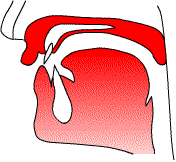
As promised in response to yesterday’s comments, here’s how I would teach the sound [ɬ], the Welsh ll as in Pontcysyllte.

This consonant is a voiceless alveolar lateral fricative. To make it you have to control the voicing (voiceless), the place of articulation (alveolar) and the manner of articulation (lateral fricative). I would teach each of these features separately, and then combine them.
To get awareness of voicing, pronounce [fvfvfv θðθðθð szszsz ʃʒʃʒʃʒ] and then [mm̥mm̥mm̥ nn̥nn̥nn̥ ll̥ll̥ll̥]. As you do so, check the voicing by covering your ears with your hands or by feeling the front of the larynx with your fingers. As you alternate between voiced and voiceless make sure that everything in the mouth remains unchanged: the only difference should be at the larynx.
Concentrate now on [ll̥ll̥ll̥]. Alveolar place should not be a problem, for native speakers of English at any rate.
(Resist any well-intentioned but misguided suggestions involving placing the tongue between or against the teeth.)
Try the English words please, plum, clear, claw. Observe that the l-sound in these words is actually devoiced, [], because of the effects of aspiration. Isolate this sound (the symbol is meant to be a letter l with a ring underneath — sorry about the shortcomings of the font). It is a voiceless lateral approximant. Note how the air escapes over the side rim(s) of the tongue. (Over both sides? Or just one, and if so which?)
(Starting from English subtlety is also misguided, since this word has lateral release of the preceding alveolar plosive, which introduces an entirely unnecessary complication. Its lateral is only slightly devoiced and is not fricative. Furthermore, it is dark, which will be inappropriate for most kinds of Welsh. Welsh ll, on the other hand, is a fricative. It does not have lateral release, just lateral escape.)
Your remaining task is to change the sound from a lateral approximant to a lateral fricative. This means that you have to narrow the gap between the side rims of the tongue and the side teeth. Try to do this while saying a long []. It should change into [ɬ].
Feel the air escaping turbulently over the side of the tongue. Keeping everything else constant, change from breathing out to breathing in. Check that you can feel a cold airstream at the side (not in the centre line). Go back to breathing out.
Lastly, we need to check the place of articulation. If you have carried out the above steps successfully, the place of articulation is still alveolar. The ll sound is a single phonetic segment, and should not have any accompanying elements. There should be no element of velar friction before, during, or after the lateral fricative. There should be no central friction (s or θ) before, during or after it. The pronunciations [xɬ, θɬ], often used by non-Welsh speakers, are not acceptable.
Try the words llaw (hand), lle (place), llo (calf), llwybr (path). Then try pell (far), twll (hole). Then allan (out), and felly (thus). Like the other Welsh voiceless consonants, [ɬ] is considerably longer intervocalically than would be the case in English: but there is no change in quality.
Make sure that you can hear and make the difference between dallu (to blind) and dathlu (to celebrate).
Practise some placenames: Llangollen, Llanelli, Machynlleth. (The last one is [maˈxənɬeθ].)
If you use [ɬ] in place of English [s], you can produce a common type of lisp (lateral sigmatism). Try [ɬɪkɬ piːɬɪɮ] (six pieces).

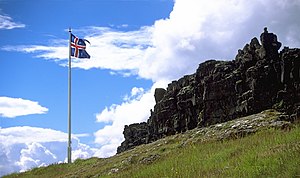
You are now equipped to pronounce not only Welsh but also Icelandic and Zulu words with this sound. Icelandic has a voiceless lateral affricate. Try fjall [fjatɬ] (mountain), Þingvellir [ˈθɪŋɡvetɬɪr] (the site of Iceland’s first parliament).


Zulu has voiceless and voiced alveolar lateral fricatives. Use your control of voicing to switch between them: [ɬɮɬɮɬɮ]. Then try -hlala [ˈɬaːla] (sit) and -dla [ɮa] (eat), not to mention amandla [aˈmaːndɮa] (power).

Lastly, do not fall foul of the “exotic sounds syndrome”. For speakers of languages that have it, [ɬ] is a perfectly ordinary sound that does not require any special effort. You, too, must use it effortlessly.
(Experts on Welsh, Icelandic and Zulu please correct me if I’m wrong anywhere.)