Wednesday, 6 February 2013

die Londoner U-Bahn

I recently came across a spoof German ‘translation’ of the London tube map, the work of one Horst Prillinger. He made it as long ago as 2004.

All the station names appear in German guise. Some are straightforward unremarkable translations, as when King’s Cross appears as Königskreuz, Westferry as Westfähre, Shepherd’s Bush as Hirtenbusch and Old Street as Alte Straße.

Others are in varying degrees ridiculous, as when East Ham becomes Ostschinken (Schinken is the German for ham, the meat product). The German for a fish’s fin is Flosse, so Finsbury Park becomes Flossenstadtpark. The map tells us that the translation uses “actual meanings, associations and sound-alike words”.

Moorgate could have retained its etymology and meaning by appearing as the cognate Moorengasse, but instead becomes Mohrentor ‘blackamoor’s gateway’. Dagenham becomes Tagesschinken, in which the -schinken part is again literally ‘ham’, but the Tages- part means ‘day’s’, perhaps because of the resemblance of English Dag- to the Dutch daag dag ‘day’, cognate with German Tag. Vauxhall comes out as Fuchshalle ‘fox shed’, although the name has nothing to do with foxes. I don’t know why my own local station, Wimbledon, features as Wunibaldshügel (Hügel means ‘hill’). And why is Clapham transformed into Schinkenklatschen (‘ham gossip’)? I suppose because klatschen also means to clap.

Harrow is rendered as Heidenhügel ‘heath hill’, though a literal translation might be Egge, which I think would have been more fun. For Barbican, Frisierdose (‘hair dressing tin’) is indeed fun, although Außenwerk would have been a literal translation.

One or two of Prillinger’s choices are of particular phonetic interest. According to David Mills’s London Place Names, the second element in Tooting Bec reflects the name of its owner from 1086, the Benedictine Abbey of St Mary of Bech (Bec-Hellouin in Normandy). So why does it become Zurücktuten? Because to a speaker of German, though not to a NS of English, ‘Bec’ is evidently a homophone of ‘back’ (zurück).

The conversion of Hounslow ˈhaʊnzləʊ into Hundslangsam ‘dog’s slow’ depends on ignoring the distinction between s and z. The native English pronunciation would rather suggest the translation Hundsniedrig or even Hundsmuhen, both ‘dog’s low’.

Ah, well. It’s ‘still a work in progress’, we read.

Tuesday, 5 February 2013

acres

I’ve been reading David Abulafia’s The Great Sea: a Human History of the Mediterranean. Now that I’ve got to the part dealing with the second millennium AD, one of the seaports I find frequently mentioned is the Levantine port known in English as Acre, in the north of what is now Israel.

I have always assumed that in English we pronounce it identically with the common noun referring to the unit of measurement equivalent to about two-fifths of a hectare, i.e. ˈeɪkə. Wikipedia, however, asserts that it is ˈɑːkə(r). I see that Merriam-Webster gives both of these possibilities as well as a third one, ˈɑːkrə.

There are various English placenames that include the element acre, or rather its OE form æcer ‘cultivated land’: for example, Sandiacre ˈsændieɪkə in Derbyshire, and also Castle Acre, South Acre and West Acre in Norfolk, all with ˈeɪkə.

On Merseyside, however, Gateacre, etymologically ‘goat-acre’, is ˈɡætəkə, with a weakened penultimate vowel.

The village of Talacre, not too far away but in north Wales, is properly tælˈækreɪ, being a Welsh compound of tâl ‘end’ plus the plural of acer from English acre. The standard Welsh plural form is, I believe, aceri; this acre must be a local variant acrau, with -au pronounced in the usual local way as e.

For the same reason Acrefair near Wrexham is properly ˌækrɪˈvaɪə (Welsh akreˈvair). Etymologically, the fair element in this name is the soft-mutated form of Mair ‘Mary’, so the name means ‘Mary’s acres’.

Monday, 4 February 2013

Polish spoken here

I returned from the Caribbean to find the newspapers excited about newly released data from the 2011 census showing that Polish is spoken by over half a million people in the UK, making it now our third most widely spoken language after English and Welsh. The Guardian launched into an editorial that started off full of phonetic technical terms …

With its mind-bending plosives, tongue-twisting fricatives and terrifying affricates, Polish is not the easiest of languages to master. Try saying Szczebrzeszyn (sounds a bit like shtebdeshin) for the merest hint of the challenges involved.
…before degenerating into ignorant silliness.
To non-Polish speakers, just saying hello sounds more like a polite sneeze than a greeting, while the combination of z with almost every other consonant creates a palette of snuffles that can be distinguished only with the most diligent study.

Why Polish plosives should be ‘mind-bending’ when English ones are presumably not is far from clear. For many NNSs I suspect that the English fricative system, with its unfamiliar θ and ð, is at least as ‘tongue-twisting’ as the Polish system with its unfamiliar x, ɕ and ʑ.

But I cannot help suspecting that is not the sounds of Polish that seem full of ‘terrifying’ ‘challenges’ so much as the unfamiliar orthographic conventions. The spellings cz, rz, sz, far from ‘creating’ a palette of snuffles, are merely unfamiliar ways of spelling sounds very similar to those we spell in English inconsistently with ch or tch (as in chop and catch) for the first, with s, z or g (as in vision, seizure and beige) for the second, and with sh, ti, ssi or various other possibilities (as in shop, position, passion, ocean, sugar etc.) for the third. OK, the Polish ʈʂ, ʐ, ʂ sound a bit ‘darker’ than English tʃ, ʒ, ʃ, being somewhat more retroflex and less palatal; but that needn’t worry us.

The town of Szczebrzeszyn ʂʈʂɛˈbʐɛʂɨn features in the longer version of a famous tongue-twister that Poles always try to get foreigners to perform: chrząszcz brzmi w trzcinie ‘a beetle is buzzing in the reed(s)’, xʂɔ̃wʂʈʂ bʐmi ft-ʂtɕiɲɛ, sometimes extended with w Szczebrzeszynie ‘in Szczebrzeszyn’ fʂʈʂɛbʐɛˈʂɨɲɛ. (Hope I’ve got all that right.)

I leave it to you to decide whether or not the Polish for ‘hello’, cześć ʈʂɛɕtɕ, ‘sounds like a polite sneeze’.

Friday, 4 January 2013

“bawl” and “ball”

In another part of the social media cybersphere Karen Chung, commenting on a picture of fractious children comforted by Santa with the caption bawl game over, asked

Are "bawl" and "ball" pronounced the same for everybody? Or differently?

I replied

I'm not aware of any variety of English in which they are distinct.

We know, of course, that many Americans do not distinguish the LOT and THOUGHT sets (although many other Americans do): but that’s not the issue. If there are people who consistently distinguish bawl from ball (and Karen insists that she is one such), then we have to recognize a split within the THOUGHT set, with an otherwise unreported choice of vowel in ball.

It turns out that for Karen ball rhymes with doll and Moll, as well as with tall, wall, fall, call, hall etc.; but not with words spelled with aul or awl, e.g. haul, maul, scrawl, trawl.

I was interested to hear this, but I continue to find it odd that there is no mention of this possibility in Kenyon’s American Pronunciation or as far as I can tell in any other descriptions of AmE phonetics. How come that no one seems to have mentioned it before?

Karen comments further

For me, the "a" in ball is the allophone of /ɑ/ which occurs before /l/ and is slightly rounded; the "au" and "aw" are the /ɔ/ phoneme, which has more inherent rounding. I expect I'm one of a minority, but it looks like others from my part of the US (Minnesota) and in my age group do have the distinction.

She also kindly supplied a sound file in support of her description.

Even if only a small number of people have this distinction, it certainly should be studied and mentioned in the literature.

We do have a comparable phenomenon in BrE, in the shape of the choice between ɔː and ɒ in words spelt als or alt — words such as false, salt, fault, halt, also. Since I knew about this at the time I wrote Accents of English, I created a special subsection (b) for THOUGHT, to cater for it (p. 146). If I’d known about Karen’s type of AmE, I’d have catered for that too: but I’d never then come across any mention of it.

There’s always something new to discover.

_ _ _

I shall be away now until the end of the month. Next blog: 4 Feb.

Thursday, 3 January 2013

conservators’ stress

How would you read this notice out loud? What intonation pattern(s) would you use? Where would you put intonation breaks? Which words would you accent? (The choice of actual tone is, as usual, less important and less constrained.)

Two breaks go, fairly obviously, at the points where the commas are written. There are optional intonation breaks at the ends of the first and second lines of writing. The nuclear accents in the resulting intonation phrases go on Conservators, responsibility, of, and from.

  • The Conˈservators | accept ˈno responsiˈbility | for ˈloss ˈof, | or ˈfrom, | …

But I think we need a further break after to, with a nuclear accent on that word.

  • The Conˈservators | accept ˈno responsiˈbility | for ˈloss ˈof, | or ˈfrom, | or ˈdamage ˈto | ˈvehicles ˈparked in this ˈcar park.

I find it difficult to explain, in terms intelligible to EFL students, just why this must be so. Perhaps my command of syntactic analysis, or logic, or pragmatics, is insufficient. OK, the items of and from are in contrast (“loss of vehicles”, “loss from vehicles”), so they receive contrastive focus. Then these categories of loss are in contrast with a further category. damage, so we need an accent there, too. But why do we need to put contrastive focus on to? Despite appearances, to is not in logical contrast with of, from, or with anything else.

But I think it would sound bizarre to read the notice aloud without a contrastive accent on to.

There must be a generalization here to be made about the accenting of prepositions in elliptical coordinated structures. Yet I am not sure what it is.

Sometimes we have a choice of accentuation patterns.

  • Any interˈference with, | or ˈdamage to, | this instalˈlation | will be subject to a fine not exceeding £500.
  • Any interˈference ˈwith, | or ˈdamage ˈto, | this instalˈlation | will be subject to a fine not exceeding £500.

_ _ _

As for the word stress in conservator, there are two possibilities in contemporary BrE, ˈkɒnsəveɪtə and kənˈsɜːvətə. The OED says (entry updated 2010)

In some 18th and 19th cent. sources (see e.g. Johnson 1755, Sheridan 1780, Smart 1849) the word is recorded with stress on the third syllable. From 1947 onwards editions of D. Jones Eng. Pronouncing Dict. distinguish between use of the word in the sense ‘official guardian’ … with stress on the second syllable and use in the sense ‘preserver’ … with stress on the first syllable.

The officials looking after Wimbledon Common are known locally as the kənˈsɜːvətəz. However I’m not sure that many people would observe Jones’s distinction consistently, so in LPD I just give both alternatives.

Wednesday, 2 January 2013

Salome

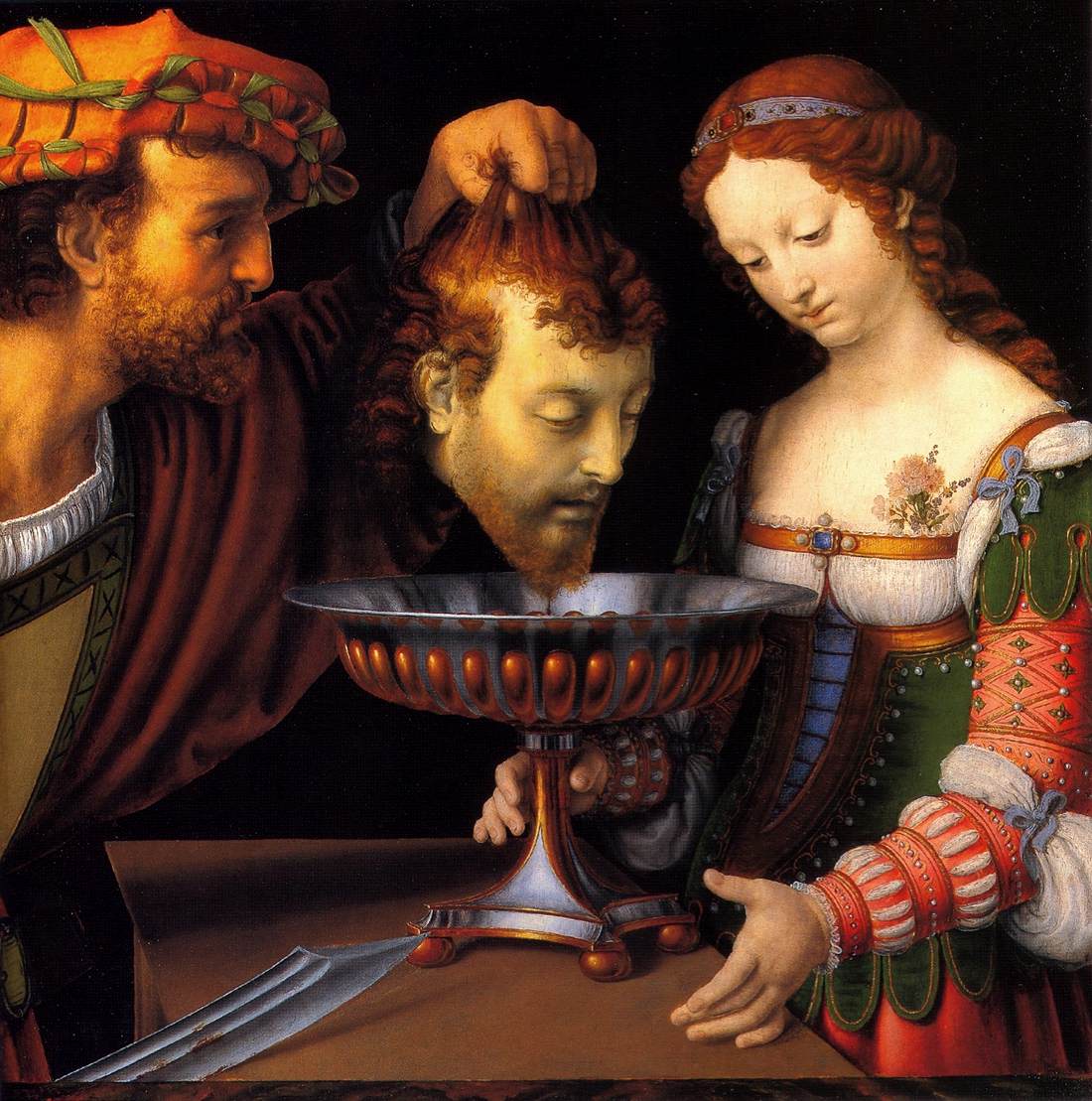
…which (that is to say, the Latin stress rule) brings us to the name Salome, borne inter alia by John the Baptist’s nemesis in gory Christian iconography. Its traditional pronunciation in English is səˈləʊmi, stressed on the penultimate and thus reflecting the long penultimate vowel and corresponding stress pattern of Latin Salōmē, from Greek Σαλώμη (where the letter omega, ω, tells you that the vowel is long).

In contemporary English, though, this is now in competition with initial-stressed ˈsæləmeɪ (which the Cambridge EPD, by the way, treats as the only American possibility, I’m not sure with what justification). The strong final vowel here may be inspired by the French version of the name, Salomé salɔme, or even the Spanish version (though in Spanish it has final stress). The initial stress can only come from applying the Latin stress rule on the mistaken assumption that the o was short.

Yesterday Jeremy Paxman had to ask a question to which the answer was Linnaeus: who wrote the Systema Naturae? But he pronounced the second word as ˈnætjʊreɪ. In Latin, of course, the u in this word is long: so the stress should be on the penultimate. Which is where we came in.

Tuesday, 1 January 2013

on the edge

And a happy new year to all of you too!

It’s many months now since we last discussed the Latin stress rule and its consequences in English. Chomsky and Halle, in their seminal The Sound Pattern of English (1968) claimed that this rule is part of English phonology, i.e. part of what native speakers know about English. Nothing demonstrates the falsity of this claim so much as the persistent failure of educated native speakers to observe it in their pronunciation of Latin names and other words.

The rule is: a Latin word in which the penultimate vowel is short and not followed by a consonant cluster has its stress on the antepenultimate. (For a longer explanation, see my blog for 27 Oct 2010.) Native speakers are supposed to be able to have inferred this from such examples as deficit, stimulus, nebula, monitor, omnibus, which meet the structural formula and are stressed on the antepenultimate (here =first) syllable, as against such examples as aroma, gladiolus, dictator, hiatus (with a long penultimate vowel) and agenda, propaganda, protector, hibiscus, professor, bacillus, colossus (with a consonant cluster after the penultimate vowel; note that in English it is consonant letters that count, not consonant sounds) — which do not meet the structural formula and accordingly take penultimate stress. (The account in SPE is actually considerably more complicated. In English, nouns are subject, it is claimed, to a further rule that says we ignore the final syllable if weak and apply the Latin rule to the remaining stem; longer words of all word classes are then likely to be subject to other rules that shift the main stress elsewhere. We’ll ignore all that.)

No one ever explicitly taught me this rule when I studied Latin as a schoolboy, but I certainly absorbed it unconsciously, since I left school knowing where to stress any given Latin word appropriately (if I knew the quantity of the penultimate vowel). So to this extent Chomsky and Halle’s claim is perhaps justified.

Not so for Jeremy Paxman, as was evident from his hosting of Christmas University Challenge on BBC2 TV yesterday evening. Although he has a degree in English from Oxford, he doesn’t know where to stress Latin words. He asked the teams a question about the meaning of the Latin mottos engraved on the rims of our £1 coins.

  • DECUS ET TUTAMEN
  • NEMO ME IMPUNE LACESSIT

We’ll forgive ˈtuːtəmen for what should be tuːˈtɑːmen , since the quantity of the middle vowel is not indicated in the spelling (though gravamen and stamen might have given him a hint). But the double ss in the spelling of lacessit indicates beyond doubt that it must be stressed ləˈkesɪt, not (as he had it) ˈlækesɪt.

What a good thing he didn’t have to attempt to pronounce the third of the £1 coin edge inscriptions — it’s in Welsh, about which I’m sure he knows even less than he does about Latin.

  • PLEIDIOL WYF I’M GWLAD

(That’s ˈpləjdjol ujv im ɡwlaːd, or anglicized ˈplaɪdiɒl ˈuːɪv ɪm ˈɡlɑːd.)