Friday, 22 February 2013

a Dutch and Afrikaans vowel

Thirty or so years ago I was staying for a few days with a friend who lived in Antwerp, when I was struck down by illness. I was admitted into a local hospital and operated on for appendicitis.

I have no complaints about the treatment I received, which was prompt, successful, and of course free of charge. But linguistically it was an interesting experience. The surgeon who operated on me spoke English with me. With the hospital chaplain I had to talk in French. But the nurses only spoke Flemish. Flemish is of course the same language as Dutch. My Dutch, though not nonexistent, is not very good. I remember being struck by the way the nurses pronounced the word for ‘soap’, zeep. I knew that this was basically zeːp, though in the Amsterdam-Rotterdam pronunciation to which I was accustomed the vowel tended to be realized as a closing diphthong, zeɪp. But in Antwerp the diphthongization was in the other direction, a Swedish-like zeəp. (See the Wikipedia account of Dutch phonetics.)

Afrikaans is like Flemish in this regard (though in that language the word for ‘soap’ is spelt seep). According to Wikipedia, in Afrikaans

/oə øə eə/ are also transcribed as long monophthongs /oː øː eː/, though it's not accurate to do so. /oə/ and /eə/ are also commonly realized as [uə] and [iə] respectively, and such pronunciation is already considered standard. In Western Cape /oə eə/ can also be pronounced [uː] and [iː] respectively.

I was thinking about this in connection with the Pistorius case currently in the news. The victim of the shooting was called Reena Reeva Steenkamp. Her surname is obviously Afrikaans (steen = ‘stone’), though I have no idea whether her first language was Afrikaans or English; apparently the family comes from the Western Cape. But I did notice one or two BBC newsreaders pronouncing her name as ˈstɪənkæmp rather than the spelling pronunciation ˈstiːn-. I think that the Afrikaans vowel in question is quite often mapped onto English NEAR ― perhaps someone can elaborate on this. The writer J.M. Coetzee, according to Wikipedia, is kʊtˈsiːə or kʊtˈsiː, though I’m sure I have also heard kʊtˈsɪə.

Monday, 18 February 2013

answering queries

Unlike some people, I have never been reluctant to allow my contact details to be available to anyone and everyone. Back in the days before email and the internet, you could find me in the phone book and on the electoral register; and if you knew that I worked at UCL you could always write to me or phone me there.

As an academic, it was obviously in my interest to make it easy for students, colleagues, prospective collaborators, publishers, and journalists to find me.

Fortunately no one has ever wanted to stalk me.

At the instigation of our departmental internet guru, Warwick Smith, I set up my homepage on the web as early as 1995, hosted on the UCL site with the same url as it has today. It has always shown my email address and my telephone number.

These details are also to be found in reference books such as Who’s Who.

So I was happy to agree to my publisher Longman’s suggestion that the CD accompanying LPD should put on the user’s screen an “Ask Professor Wells” button bringing up an email client with my email address in the “to:” field. And I regard it as one of my authorial duties to attempt to reply promptly and helpfully to the queries that readers send me.

Sometimes it can be difficult to work out from what they write the actual question that they really want to ask. And experience shows that I sometimes get it wrong.

Dear Mr. Wells,
I'm very interested in pursuing a course on phonetics. I'm already a teacher of english as a foreign language in Argentina. I know this time of the year must be busy for you, lecturing and travelling. I'd very much appreciate your advice on something I've been wondering about. I'm supposed to teach stduents who would become teacher themselves to define and consolidate the sound system of the target language. Yet, one of my coordinators told me not to stick to a particular phonemic system, which I think would be confusing since I can't teach all the possibilities available. Then I don't know how to proceed.
Kind regards,
[name]
After some hesitation I replied
I'm not sure what you mean by "a particular phonemic system". Do you mean a particular variety of spoken English (a particular accent, e.g. RP)? Or a particular transcription scheme?
In any case you are constrained by what is to be found in the dictionaries and textbooks available to your students.
There is a book you might find useful: "Practical Phonetics and Phonology: a resource book for students", by Beverley Collins and Inger Mees. It includes brief accounts of a number of different spoken varieties of English, with recorded samples.
You need to stick to one variety for in-depth study (in Argentina, presumably "BrE", i.e. RP broadly defined). But students also need to be exposed to a wide range of dfferent spoken varieties, so that they -- just like native speakers -- can cope with understanding varieties that differ from the variety they actively use themselves.
In the other direction, if I were teaching Spanish here in England, I would teach European Spanish pronunciation, including the phonemic contrast between [θ] and [s], but would not hesitate to expose my students to American Spanish, where you do not make this contrast.
This elicited the enigmatic response
Thanks for answering. I was referring, as you said, to a particular transcription scheme. What other varieties apart from RP, would you recommend? Where can I get some online material?
What I meant by “transcription scheme” was things like Upton’s OED notation as compared with the one that most dictionaries, including mine, use (see here), or non-IPA respelling systems, or a Kenyon and Knott-style system for AmE.

My correspondent’s response showed that we were still at cross-purposes. Rather than say that the obvious non-RP variety to introduce her students to in addition to RP was some kind of American English, I decided to leave the matter there.

_ _ _

Next posting: 22 Feb.

Friday, 8 February 2013

animal accents

I should never have accepted the call from that cheese company’s PR people (blog, 25 August 2006). Now, alas, I’m regarded as an expert not so much on phonetics as on animal communication.

I have been approached by a UK charity to contribute to a book in which “high-profile experts and celebrities” answer real questions from children. They want me to provide an answer, “as if chatting with a bright and curious eight-year-old”, to the question “Do animals, like cows and sheep, have accents”?

Here’s the draft I have offered. Comments (preferably helpful) welcome.

Unlike human beings, animals don’t have languages. They do produce ‘vocalizations’ (dogs bark, cats miaow, sheep bleat, cows moo, birds chirp), but these are not language, even though they are a means of communicating.
As you will know if you’ve ever watched sheepdog trials, we can teach dogs to understand quite complicated spoken instructions. But they can’t speak to us. If you’ve been out, leaving your dog in the house, you can’t ask him when you get back, “Did anyone phone while I was out?”, and he can’t tell you “The phone did ring, but I didn’t answer it. And someone knocked at the door, too.”
Different breeds of dog may have different kinds of bark, and you may even be able to recognize an individual dog’s bark just as you can an individual person’s voice. But a dog’s bark does not depend on where it grew up and who its friends are or where it went to school ― which are the main things that determine your accent or mine.
Scientists have found that whales in different oceans make different kinds of vocalization, while the calls of some species of birds similarly vary from one location to another. So we could perhaps say that whales and birds can have local ‘accents’ or ‘dialects’. But domestic cows and sheep are different. Where they grow up and live is decided by the human beings that own them.
A few years ago newspapers carried a story saying that cows in Somerset moo with a distinctive West Country accent. But the story was untrue. It had been thought up by a public relations firm working for a company selling cheese. As far as we know, Somerset cows moo in just the same way as cows in Yorkshire or Norfolk.

_ _ _

Health update: On Friday I was admitted to hospital for a hernia repair, and expected to be discharged the next day. However there has been a minor complication, and I will have to stay in hospital for a few days. So I am suspending this blog until 18 Feb (probably).

Thursday, 7 February 2013

John Trim 1924-2013

While I was away I was saddened to hear that John Trim had died.

He was the teacher who first taught me phonetics and the one who advised me to pursue a master’s degree in phonetics and linguistics with Gimson, Fry and Fourcin at UCL.

Despite his modest and unassuming nature. he inspired me and many other Cambridge undergraduates to pursue the subject. My colleague (and predecessor as head of the UCL Dept. of Phonetics and Linguistics) Neil Smith says that it was because of Trim that he became a linguist.

You can read obituary notices here and here.

For such a key figure in my own career and that of many others it is remarkable that he leaves behind very little in the way of publications: for EFL just his much loved English Pronunciation Illustrated (CUP 1965, second edition 1975), and for general and English phonetics really nothing more than his brief but brilliant 1959 article ‘ˈmeidʒər | ənˈmainə | \tounɡruːps | in\iŋɡliʃ ||’ (Maître Phonétique 112:26-29).

Despite being the founding Director of the Department of Linguistics at Cambridge, he was never promoted beyond the rank of lecturer. His main intellectual memorial is the Common European Framework of Reference for Languages, in the decades-long development of which he played a leading role (though he is not mentioned in the Wikipedia article).

Here is a scan of part of my notes from the 1959-1960 introductory phonetics course he taught at Cambridge: a fair copy of an ear-training test he gave us, in which you will see I succeeded in recognizing 83% of the tones, exotic consonants and cardinal vowels.

For us neophytes his most alarming mannerism was his silences. If you asked an apparently straightforward question, he would say nothing in reply. For five, ten, fifteen seconds you might look at him expectantly. Was your question so stupid that it didn’t deserve a reply? Had you made some terrible faux pas? Then at last the answer would come: carefully considered, beautifully expressed, full of insight.

You can see videos of a recent interview here.

Wednesday, 6 February 2013

die Londoner U-Bahn

I recently came across a spoof German ‘translation’ of the London tube map, the work of one Horst Prillinger. He made it as long ago as 2004.

All the station names appear in German guise. Some are straightforward unremarkable translations, as when King’s Cross appears as Königskreuz, Westferry as Westfähre, Shepherd’s Bush as Hirtenbusch and Old Street as Alte Straße.

Others are in varying degrees ridiculous, as when East Ham becomes Ostschinken (Schinken is the German for ham, the meat product). The German for a fish’s fin is Flosse, so Finsbury Park becomes Flossenstadtpark. The map tells us that the translation uses “actual meanings, associations and sound-alike words”.

Moorgate could have retained its etymology and meaning by appearing as the cognate Moorengasse, but instead becomes Mohrentor ‘blackamoor’s gateway’. Dagenham becomes Tagesschinken, in which the -schinken part is again literally ‘ham’, but the Tages- part means ‘day’s’, perhaps because of the resemblance of English Dag- to the Dutch daag dag ‘day’, cognate with German Tag. Vauxhall comes out as Fuchshalle ‘fox shed’, although the name has nothing to do with foxes. I don’t know why my own local station, Wimbledon, features as Wunibaldshügel (Hügel means ‘hill’). And why is Clapham transformed into Schinkenklatschen (‘ham gossip’)? I suppose because klatschen also means to clap.

Harrow is rendered as Heidenhügel ‘heath hill’, though a literal translation might be Egge, which I think would have been more fun. For Barbican, Frisierdose (‘hair dressing tin’) is indeed fun, although Außenwerk would have been a literal translation.

One or two of Prillinger’s choices are of particular phonetic interest. According to David Mills’s London Place Names, the second element in Tooting Bec reflects the name of its owner from 1086, the Benedictine Abbey of St Mary of Bech (Bec-Hellouin in Normandy). So why does it become Zurücktuten? Because to a speaker of German, though not to a NS of English, ‘Bec’ is evidently a homophone of ‘back’ (zurück).

The conversion of Hounslow ˈhaʊnzləʊ into Hundslangsam ‘dog’s slow’ depends on ignoring the distinction between s and z. The native English pronunciation would rather suggest the translation Hundsniedrig or even Hundsmuhen, both ‘dog’s low’.

Ah, well. It’s ‘still a work in progress’, we read.

Tuesday, 5 February 2013

acres

I’ve been reading David Abulafia’s The Great Sea: a Human History of the Mediterranean. Now that I’ve got to the part dealing with the second millennium AD, one of the seaports I find frequently mentioned is the Levantine port known in English as Acre, in the north of what is now Israel.

I have always assumed that in English we pronounce it identically with the common noun referring to the unit of measurement equivalent to about two-fifths of a hectare, i.e. ˈeɪkə. Wikipedia, however, asserts that it is ˈɑːkə(r). I see that Merriam-Webster gives both of these possibilities as well as a third one, ˈɑːkrə.

There are various English placenames that include the element acre, or rather its OE form æcer ‘cultivated land’: for example, Sandiacre ˈsændieɪkə in Derbyshire, and also Castle Acre, South Acre and West Acre in Norfolk, all with ˈeɪkə.

On Merseyside, however, Gateacre, etymologically ‘goat-acre’, is ˈɡætəkə, with a weakened penultimate vowel.

The village of Talacre, not too far away but in north Wales, is properly tælˈækreɪ, being a Welsh compound of tâl ‘end’ plus the plural of acer from English acre. The standard Welsh plural form is, I believe, aceri; this acre must be a local variant acrau, with -au pronounced in the usual local way as e.

For the same reason Acrefair near Wrexham is properly ˌækrɪˈvaɪə (Welsh akreˈvair). Etymologically, the fair element in this name is the soft-mutated form of Mair ‘Mary’, so the name means ‘Mary’s acres’.

Monday, 4 February 2013

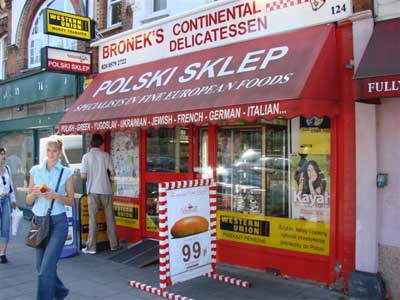
Polish spoken here

I returned from the Caribbean to find the newspapers excited about newly released data from the 2011 census showing that Polish is spoken by over half a million people in the UK, making it now our third most widely spoken language after English and Welsh. The Guardian launched into an editorial that started off full of phonetic technical terms …

With its mind-bending plosives, tongue-twisting fricatives and terrifying affricates, Polish is not the easiest of languages to master. Try saying Szczebrzeszyn (sounds a bit like shtebdeshin) for the merest hint of the challenges involved.
…before degenerating into ignorant silliness.
To non-Polish speakers, just saying hello sounds more like a polite sneeze than a greeting, while the combination of z with almost every other consonant creates a palette of snuffles that can be distinguished only with the most diligent study.

Why Polish plosives should be ‘mind-bending’ when English ones are presumably not is far from clear. For many NNSs I suspect that the English fricative system, with its unfamiliar θ and ð, is at least as ‘tongue-twisting’ as the Polish system with its unfamiliar x, ɕ and ʑ.

But I cannot help suspecting that is not the sounds of Polish that seem full of ‘terrifying’ ‘challenges’ so much as the unfamiliar orthographic conventions. The spellings cz, rz, sz, far from ‘creating’ a palette of snuffles, are merely unfamiliar ways of spelling sounds very similar to those we spell in English inconsistently with ch or tch (as in chop and catch) for the first, with s, z or g (as in vision, seizure and beige) for the second, and with sh, ti, ssi or various other possibilities (as in shop, position, passion, ocean, sugar etc.) for the third. OK, the Polish ʈʂ, ʐ, ʂ sound a bit ‘darker’ than English tʃ, ʒ, ʃ, being somewhat more retroflex and less palatal; but that needn’t worry us.

The town of Szczebrzeszyn ʂʈʂɛˈbʐɛʂɨn features in the longer version of a famous tongue-twister that Poles always try to get foreigners to perform: chrząszcz brzmi w trzcinie ‘a beetle is buzzing in the reed(s)’, xʂɔ̃wʂʈʂ bʐmi ft-ʂtɕiɲɛ, sometimes extended with w Szczebrzeszynie ‘in Szczebrzeszyn’ fʂʈʂɛbʐɛˈʂɨɲɛ. (Hope I’ve got all that right.)

I leave it to you to decide whether or not the Polish for ‘hello’, cześć ʈʂɛɕtɕ, ‘sounds like a polite sneeze’.